
Electrical Contractor Invoice Template (2026): Editable Pack and Example

On this page8
An electrical contractor invoice template links the bill to the work supplied and its accepted scope. Separate parts, labour and agreed changes where the billing basis calls for them. Keep the invoice readable; it is not an installation or compliance certificate.
Name the job, invoice record ID, accepted bid revision, work billed, tax and payment terms. List devices, fittings or measured work with clear units when you bill by amount. Record payments apart from the first total. This is a billing record. It does not certify that electrical work meets trade needs.
Page updated 25 October 2026. Source check dates are reported separately in the text and comparison.
Electrical contractor invoice template fields
| Field | What to enter | Check |
|---|---|---|
| Job record ID | Client site and project number | Match the accepted bid |
| Invoice record ID | Unique number and issue date | Keep sent versions |
| Scope basis | Accepted proposal and revision | Avoid an old draft |
| Work scope note | Real billed task | Do not claim work not supplied |
| Devices or fittings | Type, count and unit where linked | Distinguish supplied and fitted |
| Goods | Agreed selling items | Keep private buy prices out |
| Labour | Billing unit and agreed sell basis | Do not mix crew-hours and person-hours |
| Change record ID | Agreed added or removed scope | Keep the related agreement |
| Completion records | Named handover files where needed | Invoice is not a substitute |
| Tax and total | Resolved basis and amount | Use the applicable transaction treatment |
| Payments and balance | Receipt records and remaining amount | Do not reduce first total |
Scroll for more →
Complete the electrical contractor invoice template
Start from the accepted electrical bid. Check its revision and any chosen alternatives. If the bid covered fitting owner-supplied lights, do not add the light buy as a selling line unless the scope changed. State what you actually supplied and what you fitted.
Use the job's own record IDs for circuits, equipment or areas. The client needs enough detail to match the bill with the work package. A single line saying “electrical” may be too broad when several areas or phases are involved. Keep trade test results in the needed handover record, named apart if appropriate.
Worked billing example
Imagine an office-room lighting job with eight owner-supplied fittings. The accepted offer covers fitting those lights, the listed wiring work and the agreed handover records. A later control change is approved under CH-01. The invoice names the base offer and CH-01 on distinct lines.
The seller uses checked selling amounts, not the private labour cost or vendor cost. If an earlier payment exists, it appears after the first total with its receipt record ID. The balance reflects that payment. This example is made-up and gives no market rates, device design or install work steps.
Keep units and work stages clear
An hour can mean one person's hour or a crew-hour. Label it so the sell rate has the same basis. An item count should name the item type. If you bill by measured run, state the length unit and agreed measurement basis.
For staged work, name the billable stage rather than using an unlabelled percent. Keep earlier invoices and payments traceable so a stage is not billed twice. Do not treat a template milestone as a default deposit or a statement that the stage has been completed.
Tax and changes
The seller supplies the tax basis and rate. The form does not assume that all electrical labour or all parts have one tax treatment. Resolve the linked rule for the real transaction before issuing the invoice. A broad trade label is not a tax classification.
Keep each agreed change beside its scope and amount. If a site condition is still being discussed, an invoice line does not settle the dispute. Update the underlying record through the agreed job process. Then issue the corresponding billing record.
Client-copy checks
Use a separate Word or PDF file. Check it for private costs, comments and other clients. Match invoice record ID, project, accepted scope and amount due. Check the final page breaks so the total remains with its label.
The general invoice guide explains payment and balance treatment in more detail.
The GAO guide supports maintaining a defined scope and documented updates. It does not prescribe electrical invoicing law or certify work. Source checked 15 October. Full revision date is above.
For billing handoff options, see the invoicing comparison.
FAQ
Does this invoice certify electrical work?
No. It records a payment request for identified work. Required inspection, test or handover records have their own purpose. They must follow the actual project requirements. Reference them where useful, but do not replace them with a billing statement or imply that a paid invoice proves technical compliance.
Can I bill a change that was only discussed?
Check the agreement and change process before billing. Record what was requested, what was accepted and the pricing basis. A conversation note alone may not settle the issue. Keep open scope visible in your private records and do not imply that this form creates acceptance of extra work.
How do I record a disputed line?
Keep the issued invoice intact. Note which line the client disputes and save the reply. Check it against the accepted scope and change record before issuing a correction.
Verdict on the electrical contractor invoice template
Use the electrical contractor invoice template to connect billed work, accepted scope and payment records. Keep trade certification separate and send only the client-facing amounts.
Inside the original file
This is the actual A4 example from the editable pack, version 1.0.0. All names, measurements, dates and amounts are invented for the form demonstration.
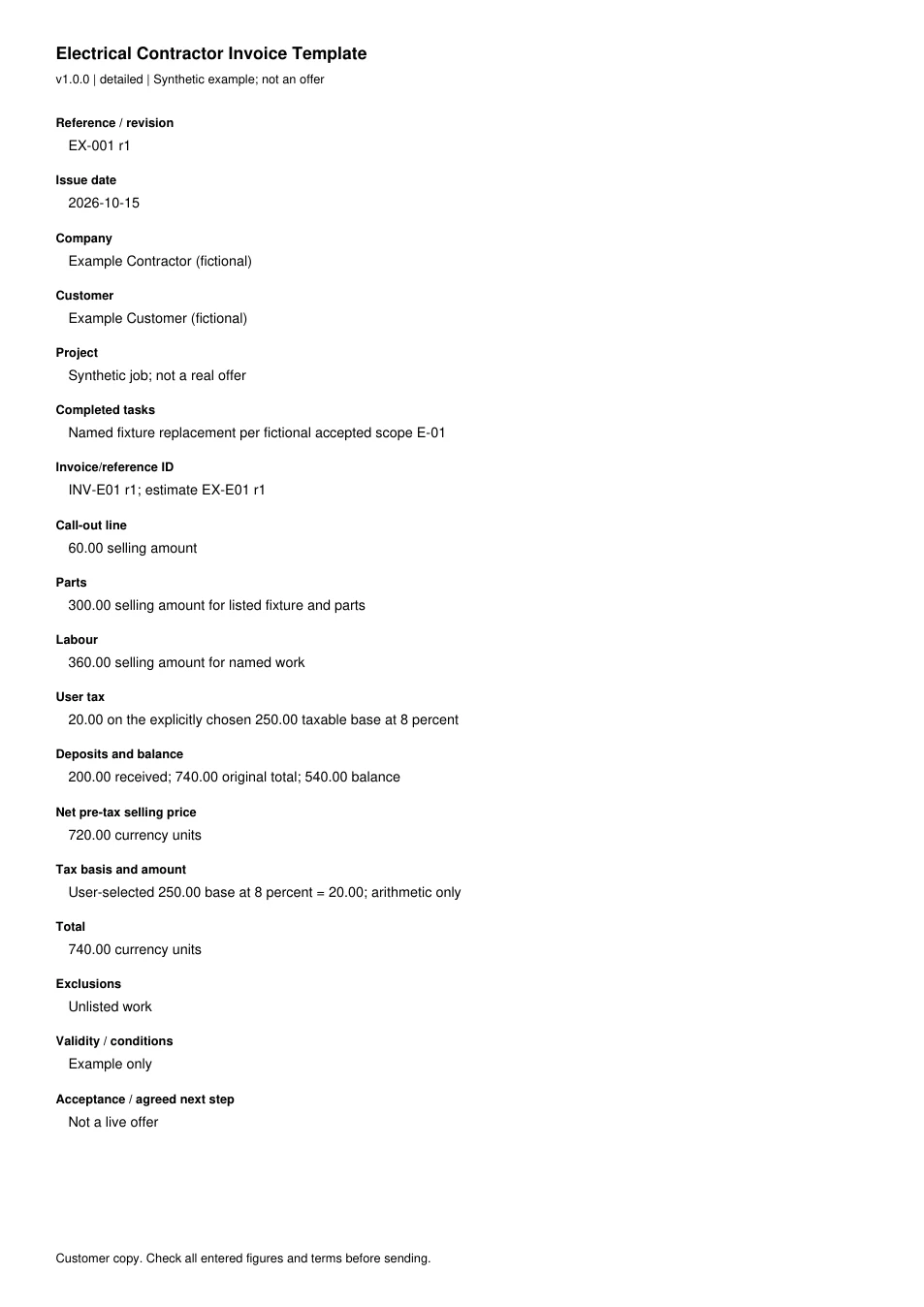
Read every field in the example
- Reference / revision
- EX-001 r1
- Issue date
- 2026-10-15
- Company
- Example Contractor (fictional)
- Customer
- Example Customer (fictional)
- Project
- Synthetic job; not a real offer
- Completed tasks
- Named fixture replacement per fictional accepted scope E-01
- Invoice/reference ID
- INV-E01 r1; estimate EX-E01 r1
- Call-out line
- 60.00 selling amount
- Parts
- 300.00 selling amount for listed fixture and parts
- Labour
- 360.00 selling amount for named work
- User tax
- 20.00 on the explicitly chosen 250.00 taxable base at 8 percent
- Deposits and balance
- 200.00 received; 740.00 original total; 540.00 balance
- Net pre-tax selling price
- 720.00 currency units
- Tax basis and amount
- User-selected 250.00 base at 8 percent = 20.00; arithmetic only
- Total
- 740.00 currency units
- Exclusions
- Unlisted work
- Validity / conditions
- Example only
- Acceptance / agreed next step
- Not a live offer