
Roofing Estimate Template (2026): Editable Worksheet and Example

On this page8
A roofing estimate template needs a roof-by-roof scope, not just one area and a total. List removal, covering, flashings and waste handling as distinct work. Keep unknown concealed repairs separate from the known replacement scope.
Record each roof plane and how it was measured. Name the covering, underlayment, edges, vents and removal layers from the job documents. Price access and disposal explicitly. The form organizes the offer. It does not select an assembly, establish safe access or diagnose hidden damage. Unknown repairs stay unresolved.
Page updated 25 October 2026. Source check dates are reported separately in the text and comparison.
Roofing Estimate Template preview
| Trade field | Blank entry rule | Filled synthetic example |
|---|---|---|
| Roof plane | Reference the measured plane and method | Plane A, measured from the project plan |
| Area | State actual surface area and unit | Two separately listed planes |
| Tear-off | Record known layers and included removal | One known layer. Hidden layers open |
| Covering | Use chosen product and buy unit | User-chosen covering, no brand assumed |
| Underlayment | Reference the specified assembly | Per project specification |
| Flashings | List edge and junction scope | Chimney junction listed separately |
| Vents | Count and name supply duty | Existing vents to be checked |
| Disposal | State collection, transport and receiving basis | Waste removal line included |
| Allowances | Name open work and resolution method | Concealed deck repair not yet priced |
Scroll for more →
Measure and define the roof work
Keep each plane in the takeoff so you can check a changed dimension. A footprint area is not on its own the sloped roof area. Record how the area was obtained and which units it uses. Do not use a guessed pitch factor to make a figure look complete.
Separate measured work from purchased covering. The chosen product's packaging and the real layout affect what you order. Use manufacturer instructions for the chosen system, including the linked edges and junctions. This page supplies no fixed waste percent or install work detail.
Work through a replacement example
Imagine a made-up roof replacement with two measured planes. The private worksheet has one covering line per plane, a removal line and distinct flashing work. Disposal is included. A possible deck repair is recorded as open because it cannot yet be measured.
Do not spread an invented repair amount over the known covering area. Define an allowance or change method through the real agreement. If another layer is found, record the changed scope and revision before changing the client total.
Build a readable client copy
Group selling lines by task. Separate removal, roof assembly, junctions and waste. Keep supplier costs and markup private. State what happens to gutters, vents and nearby surfaces. The word “replacement” should not imply unlisted work.
Check access, delivery and protection against the site conditions. These are scope questions, not reasons to copy a standard rate from a distinct roof. Do not claim the example shows a completed job or a tested roofing method.
Our scope records follow the GAO cost guide. We checked it on 15 October. It does not design a roof or set local prices. Use the takeoff guide to record where each measurement came from.
Find the next trade worksheet
Surface and finish work: painting, drywall, flooring, concrete and decks.
Repairs and systems: handyman tasks, home repair, HVAC, plumbing and remodeling.
Cleaning: general, commercial, carpet, windows and pressure washing.
Outdoor services: landscaping, lawn care, tree removal, snow removal, pool work and junk removal.
Two roof planes: quantity and cost check
This fictional exercise uses measured sloped areas of 720 and 480 square feet. Their sum is 1200 square feet. Neither figure is a building footprint.
Suppose the chosen covering in this exercise comes in packs that cover 30 square feet. A user-entered ten percent layout allowance makes the planning amount 1320 square feet, or 44 packs. These are invented packaging and allowance inputs, not a roof-system specification.
At a made-up cost of $42 per pack, covering costs $1848. Keep that supply amount separate from removal and fitting. Suppose the private job notes allow 18 person-hours for removal and 30 for the defined fitting work, both at a fictional $30 cost per person-hour. Those tasks cost $540 and $900. They do not establish a safe crew size or a real work speed.
The example also has $210 for the specified flashing goods, $120 for delivery and $280 for waste collection. The known cost subtotal is $3898. Check it by adding 1848, 540, 900, 210, 120 and 280. No concealed deck repair enters this subtotal. It remains open, so this is a known-scope subtotal rather than a complete final job price.
Check what changed after opening the roof
Suppose later evidence identifies a bounded repair. Give it a location, measured quantity and agreed work description. Add its goods and task costs only after those inputs are known. A repair changes the cost basis; it does not change the measured roof area. Keep any revised covering order separate from the repair record so the two changes remain explainable.
Check whether the removal allowance covered the layer count actually found. If the scope changes from one layer to two, revisit handling and waste as well as labour. Do not simply double the entire roof total. Delivery, flashing goods and other unchanged lines may have no reason to double.
Read the price against the roof schedule
The client description should identify the two planes and the agreed covering. It should also name the flashing junctions, removal boundary and waste duty. Check whether the price includes gutters or only the roof edge work. A pack count cannot resolve that question.
For the private arithmetic after this subtotal, use the shared pack field reference. It explains markup, tax inputs and payments once. Keep this roof's plane schedule and unresolved repair beside that calculation; they are the evidence for the amounts you enter.
FAQ
What if the covering order needs another delivery?
Keep the first delivery charge with its quoted scope. Ask whether a later top-up order has a separate trip fee. Do not assume the first charge covers all future deliveries. Link any added order to the plane or repair that caused it. Check whether it changes the programme too. A goods shortfall can affect the work plan even when the extra packs cost little. Keep that effect visible in the revised offer.
Does this form calculate a safe roof design?
No. It records scope and price. Use the actual project design and chosen roof system. Keep unresolved choices open. Enter the agreed assembly only once it is known. The form cannot tell you which structure or fitting method is suitable.
Area is a measurement, not a design check.
Should concealed repairs be priced at zero?
Keep them open until the condition and amount are known. If your agreement uses an allowance or a defined change method, state it clearly. A blank field is not a promise to do unlimited repair work for no charge. Update scope and price together once the issue is resolved.
Verdict on the roofing estimate template
Use the roofing estimate template to separate measured roof work from open repairs and unselected options. Keep each plane and junction traceable. The pack example checks the selling-price calculation; the directory above links the other trade worksheets.
Inside the original file
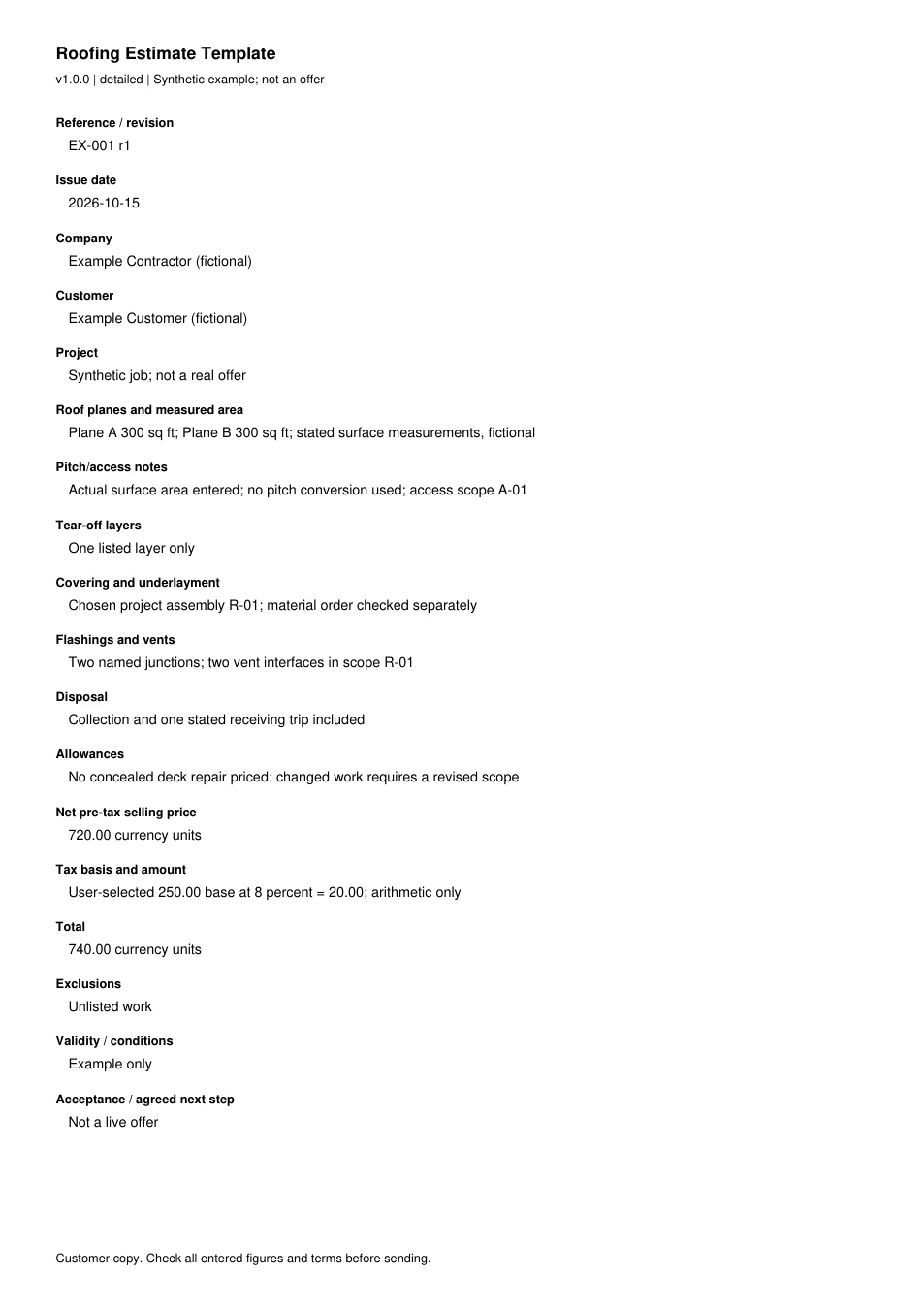
This is the actual A4 example from the editable pack, version 1.0.0. All names, measurements, dates and amounts are invented for the form demonstration.
Read every field in the example
- Reference / revision
- EX-001 r1
- Issue date
- 2026-10-15
- Company
- Example Contractor (fictional)
- Customer
- Example Customer (fictional)
- Project
- Synthetic job; not a real offer
- Roof planes and measured area
- Plane A 300 sq ft; Plane B 300 sq ft; stated surface measurements, fictional
- Pitch/access notes
- Actual surface area entered; no pitch conversion used; access scope A-01
- Tear-off layers
- One listed layer only
- Covering and underlayment
- Chosen project assembly R-01; material order checked separately
- Flashings and vents
- Two named junctions; two vent interfaces in scope R-01
- Disposal
- Collection and one stated receiving trip included
- Allowances
- No concealed deck repair priced; changed work requires a revised scope
- Net pre-tax selling price
- 720.00 currency units
- Tax basis and amount
- User-selected 250.00 base at 8 percent = 20.00; arithmetic only
- Total
- 740.00 currency units
- Exclusions
- Unlisted work
- Validity / conditions
- Example only
- Acceptance / agreed next step
- Not a live offer