
Commercial Cleaning Estimate Template (2026): Editable Worksheet and Example

On this page7
A commercial cleaning estimate template separates zones, tasks and service frequencies. Office area alone does not define the work. Record access windows, restroom tasks and responsibility for consumables before pricing the schedule.
Build a zone-by-task schedule with visit frequency and the available work window. Keep nightly, weekly and periodic work distinct. State whether consumables and restocking are included. Use your own labour basis. No universal production rate is supplied. The client copy should show service frequencies without exposing private staffing costs.
Page updated 25 October 2026. Source check dates are reported separately in the text and comparison.
Commercial Cleaning Estimate Template preview
| Trade field | Blank entry rule | Filled synthetic example |
|---|---|---|
| Zones | Name areas apart | Office floor, entrance and restrooms |
| Cleanable area | Record measurement and exclusions | User-measured included area |
| Shift window | Use real permitted hours | After-hours access window to be agreed |
| Nightly tasks | Set out repeat actions | Bins and listed floor work |
| Weekly tasks | Keep separate from nightly work | Named detail tasks |
| Restrooms | List fixtures and tasks | Fixture count and restocking scope |
| Consumables | State supply and refill duty | Client supplies stock. Refill service listed |
| Access | Record keys, alarm and restricted spaces | Restricted room excluded |
Scroll for more →
Zone and frequency matrix
Use one row for each task and zone. State when each task occurs. Keep nightly floor work apart from weekly detail work. A single cleaning allowance can hide that difference. Count the actual service dates before you turn a visit price into a period amount.
Check the usable work window. Time spent waiting for access or working around occupied areas may affect your plan. Record those basis notes rather than assuming a vacant building. Keep security details in a private operational record, not a broadly shared quote.
Office example
A made-up office request includes nightly bin and floor tasks, weekly detail work and restroom restocking. The worksheet separates these schedules. The client gives consumable stock. The contractor includes the named refill task.
Buying the stock is not in that example price.
If the client asks for daytime cover later, treat it as changed scope. Define the cover hours and duties instead of multiplying the nightly price by another shift. Keep the prior schedule so the new offer can be compared with the accepted one.
Check supplies and exclusions
List what “consumables included” means if you offer them. Product amount and choice depend on the real site and service. Do not claim a health or disinfection result from a general cleaning template. Any specialist service needs its own defined method and linked needs.
State restricted areas, periodic work and tasks by others. An exclusion should not clash with the task matrix. Check the client copy against both before sending. A clear schedule is more useful than a long promise that everything is covered.
Use the general cleaning worksheet for simpler residential task lists and window cleaning for pane and access scope. The basis note method follows the GAO guide, checked 15 October. It supplies no site production rate.
Work an office service month by frequency
This invented office example has twenty scheduled nightly visits and four weekly detail visits in a named service period. Nightly tasks take 2.5 person-hours per visit in the example work plan. That makes 50 person-hours. Weekly detail adds 1.5 hours on each of four dates, or six hours. Total planned labour is 56 person-hours, not twenty times the combined nightly and weekly time.
At a fictional labour cost of $25 per person-hour, labour costs $1400. Add $80 of cleaning supplies and $100 for the defined travel basis. The known monthly cost is $1580. Restroom paper and soap are client-supplied in this example. Refilling them is in the task time; buying them is not in the $80 supply amount.
If a fifth weekly detail date falls within the next period, its extra 1.5 person-hours add $37.50 at the example rate. Recount the nightly dates too. Do not keep the same monthly cost merely because the floor area has not changed. Conversely, a fixed agreed service price needs its own terms; this date-based cost model does not decide those terms.
Check the access window against person-hours
An office may permit only a short evening work window. Person-hours and clock hours are different units. Two people working for the full 2.5-hour window would provide five person-hours. That is twice the nightly task allowance above, not the same allowance with a larger crew label.
Use the actual staffing plan to check whether the scheduled work fits the permitted window. Include any known time for access, setup and lockup in the relevant task basis. Keep alarm codes and key details out of the client quote. The quote needs the access duty and timing boundary, not private security instructions.
Stop consumable supply from becoming unlimited
If the client asks the contractor to buy restroom stock, define the goods and supply basis before pricing that addition. Keep restocking labour distinct from purchasing. A line that says “restrooms included” leaves both duties unclear. State whether stock remains client-supplied while that choice is open.
The offer should also distinguish periodic floor treatment from nightly floor cleaning. In this example no periodic treatment cost is included. Adding it requires its own areas, dates and service description. It should not appear as an unexplained increase in the nightly rate.
Check the final schedule one zone at a time: entrance, office spaces and each restroom. Match each task to its frequency and priced date count. Use the pack field definitions for the remaining calculation. Keep this frequency matrix with the period estimate so a changed calendar can be priced without guessing.
FAQ
How do I keep floor care from being counted twice?
Name the nightly task and the periodic task separately. Check which dates and areas each covers. If one replaces another on a stated night, do not add both full time allowances without checking the plan. Record any setup that both tasks share. A weekly floor-care line should not silently add a second full nightly clean. Keep the zone schedule with the cost notes so the client can see the service frequency while your staff can check the work basis.
Can area alone decide the price?
No. Area is one input, but the tasks, condition, frequency and access window also define the work. Record the basis for your own hours and costs. This form supplies no fixed area-per-hour basis note.
Keep distinct task frequencies visible so an office total does not hide a missing service.
How should consumables appear?
Name who buys stock and who refills it. If you supply products, state the amount or basis you include. List any limits. Buying stock and doing the refill work are separate tasks. A service price should not imply an unlimited stock supply. Check that the task schedule and price say the same thing.
Verdict on the commercial cleaning estimate template
Use the commercial cleaning estimate template to keep zones, tasks and frequencies tied to the offer. Start with the pack arithmetic for the whole-job calculation. Find other job sheets in the trade directory.
Inside the original file
This is the actual A4 example from the editable pack, version 1.0.0. All names, measurements, dates and amounts are invented for the form demonstration.
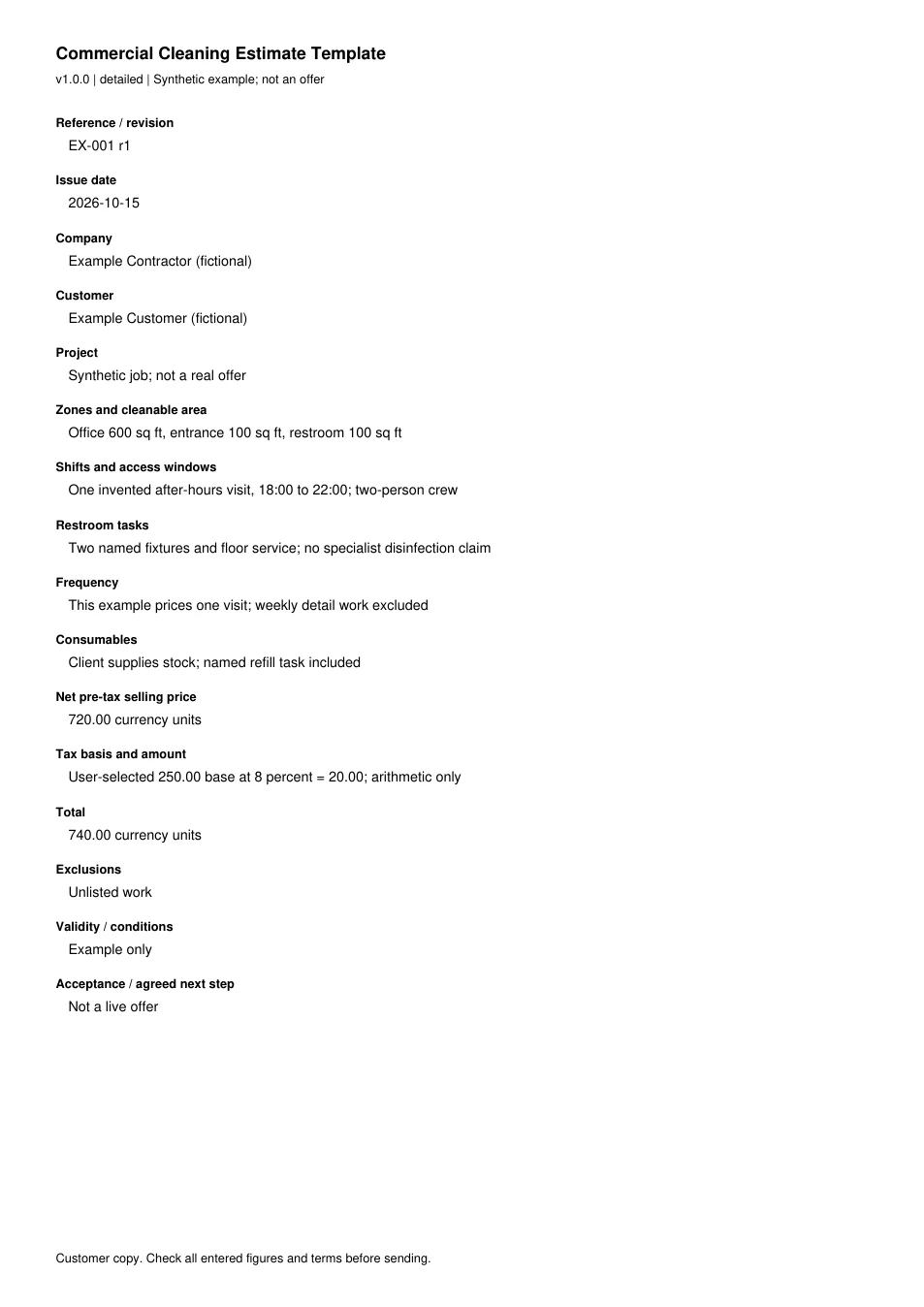
Read every field in the example
- Reference / revision
- EX-001 r1
- Issue date
- 2026-10-15
- Company
- Example Contractor (fictional)
- Customer
- Example Customer (fictional)
- Project
- Synthetic job; not a real offer
- Zones and cleanable area
- Office 600 sq ft, entrance 100 sq ft, restroom 100 sq ft
- Shifts and access windows
- One invented after-hours visit, 18:00 to 22:00; two-person crew
- Restroom tasks
- Two named fixtures and floor service; no specialist disinfection claim
- Frequency
- This example prices one visit; weekly detail work excluded
- Consumables
- Client supplies stock; named refill task included
- Net pre-tax selling price
- 720.00 currency units
- Tax basis and amount
- User-selected 250.00 base at 8 percent = 20.00; arithmetic only
- Total
- 740.00 currency units
- Exclusions
- Unlisted work
- Validity / conditions
- Example only
- Acceptance / agreed next step
- Not a live offer