
Concrete Estimate Template (2026): Editable Worksheet and Example

On this page7
A concrete estimate template separates measured volume from the rest of the slab work. Record dimensions with their units. Then list preparation, formwork, reinforcement, delivery and finish. A volume formula does not choose a structural design or check the final order.
For a rectangular slab, use feet for length and width. Divide thickness in inches by twelve to get feet. Multiply the three dimensions for cubic feet, then divide by twenty-seven for cubic yards. Keep waste, order rounding and other work separate. This form does not specify slab thickness, reinforcement or mix.
Page updated 25 October 2026. Source check dates are reported separately in the text and comparison.
Concrete Estimate Template preview
| Trade field | Blank entry rule | Filled synthetic example |
|---|---|---|
| Length | Measure the defined rectangle in feet | 12 ft, synthetic example |
| Width | Use the same area basis | 10 ft |
| Thickness | Enter the specified thickness in inches | 4 in, arithmetic only |
| Net volume | Convert all dimensions before multiplying | 12 x 10 x 4 / 12 / 27 cubic yards |
| Waste | User enters their own basis note | No fixed default |
| Order unit | Check vendor amount and rounding | User-entered delivery increment |
| Formwork | Measure real edges and tasks | Edges listed apart |
| Reinforcement | Use the real project spec | No design supplied |
| Finish and delivery | Name the scope and access basis | Finish, delivery and access lines |
Scroll for more →
Work the volume from the units
The made-up rectangle is twelve feet by ten feet. It is four inches thick. Divide four by twelve to convert thickness to feet. Multiply the dimensions, then divide by twenty-seven. Net volume is about 1.481481 cubic yards.
This is geometry, not a recommended slab size.
For this made-up example, add ten percent waste. The result is about 1.629629 cubic yards before order rounding. This is an arithmetic check, not a recommended waste rate. The blank file has no default.
Keep the net volume, waste and order rounding in separate fields. A vendor minimum does not change the measured slab.
Price the complete slab scope
Concrete volume is one part of the offer. List preparation or excavation if included. State removal and disposal limits. Record forms, reinforcement, placement and finish from the project scope.
Name who handles the specified curing tasks. A volume rate need not cover them all. Match each included task to the price before you send the offer.
Keep unknown ground conditions unresolved. If you use an allowance, name its scope and how a changed quantity affects the price. This example does not establish a suitable foundation or safe excavation. It supplies no structural specification.
Check the order and client copy
Check the chosen vendor's ordering unit, delivery access and other charges. Keep the first vendor quote record ID in private costing. A minimum order, waiting condition or delivery increment is a price input, not part of the geometric formula.
The client scope should show the defined slab and included tasks. Keep private rates and margin out. Use the takeoff guide for measurement records and the estimating guide for the cost sequence.
The dimensions and conversion were worked through from feet, inches and cubic-yard definitions. Currency rounding follows Microsoft ROUND. Scope basis notes follow the GAO method. Checked 15 October.
No concrete price or engineering result is claimed.
Convert the slab quantity into a delivery cost
Continue the fictional 12 by 10 foot slab above. Its four-inch thickness is an arithmetic input only. Net volume is about 1.481481 cubic yards. The example's ten percent allowance gives about 1.629630 cubic yards.
Suppose an invented vendor sells in quarter-yard steps with no other minimum. Rounding up gives 1.75 cubic yards. Record all three quantities so the ordered amount does not replace the net measurement.
At a made-up cost of $180 per cubic yard, the concrete supply line is $315. Add a fictional $90 delivery charge. Do not multiply the delivery charge by 1.75 unless the quote actually uses a per-yard delivery basis. If the vendor instead has a two-yard minimum, recalculate that scenario as $360 supply plus $90 delivery, or $450. The minimum changes supply cost, not the slab's dimensions.
Price the edges and tasks outside volume
The rectangle has a perimeter of 44 feet: twice the sum of twelve and ten. Suppose all four edges need the formwork scope described in this example. At a fictional $3 per foot of form goods, that line costs $132. A slab against an existing edge might have a different formed length. Confirm the actual boundary instead of always using the full perimeter.
Assume the private task plan has eight person-hours for the specified preparation, six for forms and twelve for placement and the named finish. These 26 person-hours at a made-up $30 cost rate total $780. Add $110 for the separately specified reinforcement goods and $95 for the defined waste duty. With the 1.75-yard supply case and delivery, known cost is $1522: 315 plus 90 plus 132 plus 780 plus 110 plus 95.
Those amounts do not establish a suitable mix, reinforcement design, curing method or crew plan. They show how to keep each cost tied to a different scope input. Use the actual project specification for the work and real vendor terms for the supply.
Check the conditions attached to the delivery
Before calling this a complete price, review what the vendor quote says about waiting, access and unused material. A quoted delivery amount does not prove every possible charge is included. Leave a charge unresolved if its basis is not yet known. Do not enter zero simply because the known subtotal already looks plausible.
Keep excavation and removal limits beside the slab schedule. If new ground work appears, measure and price that change separately. The shared pack cost reference explains later price steps; the slab dimensions, order increment and edge schedule explain this concrete subtotal.
FAQ
What if the slab is split into two pours?
Keep the measured volume for each pour and check each order against the vendor's terms. A minimum or delivery fee can apply to each order rather than once to the combined volume. Revisit forms, return visits and the named finish tasks too. Do not assume that halving the volume halves every cost. Record why the work is split and which charges change. The worksheet should show the order sequence without claiming that it designs the pour method.
Does the example specify a suitable slab?
No. The dimensions are invented to show unit conversion. Thickness, reinforcement, mix and other needs must come from the real project design and conditions. This worksheet calculates a stated rectangular volume only.
It does not validate a structural or ground design or give install work instructions.
Should I order the exact net volume?
Check the ordering basis with your chosen vendor and record your own waste basis note. Keep net geometry, added amount and buy rounding distinct. The sheet supplies no fixed waste rate or minimum order. Check the final amount against the real geometry and vendor conditions before placing an order.
Verdict on the concrete estimate template
Use the concrete estimate template to distinguish net slab geometry from ordering and the full work scope. Keep formwork, delivery and finish visible. Check the price calculation separately, and use the trade directory for related site work.
Inside the original file
This is the actual A4 example from the editable pack, version 1.0.0. All names, measurements, dates and amounts are invented for the form demonstration.
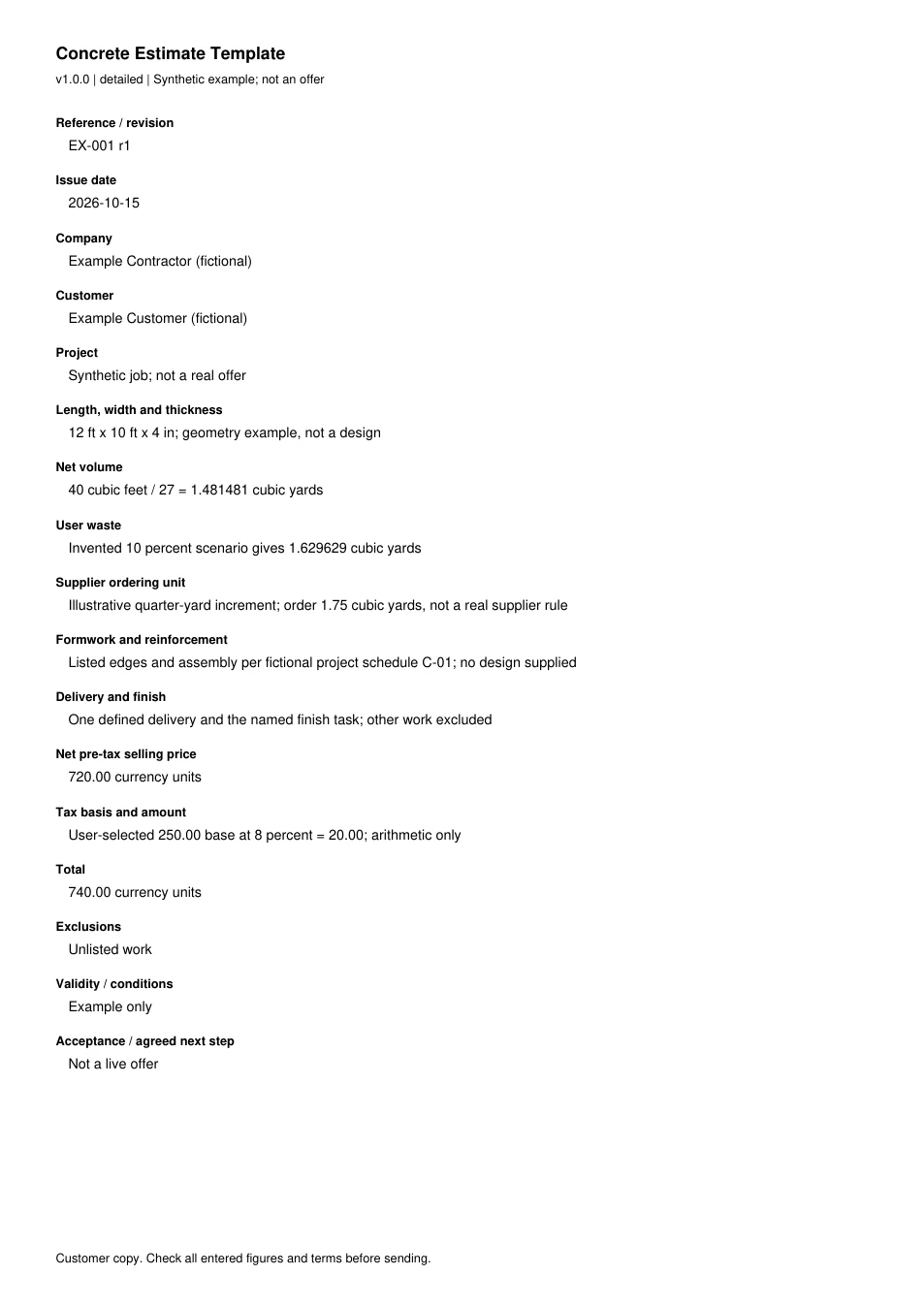
Read every field in the example
- Reference / revision
- EX-001 r1
- Issue date
- 2026-10-15
- Company
- Example Contractor (fictional)
- Customer
- Example Customer (fictional)
- Project
- Synthetic job; not a real offer
- Length, width and thickness
- 12 ft x 10 ft x 4 in; geometry example, not a design
- Net volume
- 40 cubic feet / 27 = 1.481481 cubic yards
- User waste
- Invented 10 percent scenario gives 1.629629 cubic yards
- Supplier ordering unit
- Illustrative quarter-yard increment; order 1.75 cubic yards, not a real supplier rule
- Formwork and reinforcement
- Listed edges and assembly per fictional project schedule C-01; no design supplied
- Delivery and finish
- One defined delivery and the named finish task; other work excluded
- Net pre-tax selling price
- 720.00 currency units
- Tax basis and amount
- User-selected 250.00 base at 8 percent = 20.00; arithmetic only
- Total
- 740.00 currency units
- Exclusions
- Unlisted work
- Validity / conditions
- Example only
- Acceptance / agreed next step
- Not a live offer