
Cleaning Estimate Template (2026): Editable Worksheet and Example

On this page7
A cleaning estimate template distinguishes the first clean from repeat maintenance. Use a room-and-task list, not a single label such as “full clean.” State visit frequency and the basis for the time you price.
Record rooms, tasks, first-clean scope, recurring scope, labour and supplies. Keep one-off extras outside the recurring price unless selected. A per-visit price and a monthly amount need an explicit visit count. An initial clean need not take the same time as maintenance; use the actual task basis for each.
Page updated 25 October 2026. Source check dates are reported separately in the text and comparison.
Cleaning Estimate Template preview
| Trade field | Blank entry rule | Filled synthetic example |
|---|---|---|
| Rooms and zones | Name included spaces | Kitchen, living room and bath |
| Task list | Use actions with limits | Wipe accessible surfaces. Floor service as described |
| First clean | Record the initial condition and extra tasks | Initial detail clean priced apart |
| Maintenance | List repeat tasks | Regular floor and surface scope |
| Frequency | State visits and period | User-entered weekly schedule |
| Labour | Use your own hours and rate basis | Initial and repeat time kept distinct |
| Supplies | State who gives them | Contractor consumables listed |
| Extras | Exclude until chosen | Oven interior optional |
Scroll for more →
Build a task schedule
List tasks by room so the client can spot gaps. “Kitchen” might mean accessible surfaces only or also appliance interiors. Name the service you offer and the surfaces it covers. Record access limits and items that the client must clear before the visit.
Separate the initial visit from routine work. A first clean may involve distinct tasks or conditions, but the worksheet should record your real basis rather than presume a fixed multiplier. Use distinct time entries for the initial and recurring scope.
Initial and recurring example
An imaginary client asks for an initial detail clean followed by repeat visits. The initial line includes the named extra tasks. The repeat line covers only the maintenance schedule. Oven cleaning is an option and does not enter either base total until chosen.
Show the price per visit and the planned visit count. Name the period that count covers. Some months have more service dates than others. State whether the bill follows actual visits or an agreed fixed schedule. Do not use a guessed month length to create a fixed price.
Prepare the offer
State who supplies consumables, how the cleaner enters and which tasks are outside the service. Keep product selection and surface suitability tied to the real work. This price form gives no disinfection, health or stain-removal guarantee.
A client copy needs the task schedule and price basis, not your private time-cost detail. Save the accepted version before updating a recurring schedule. If the rooms or frequency change, issue an updated scope rather than silently reusing the old amount.
For shift-based premises, use commercial cleaning. For carpet work, use the carpet worksheet. The GAO method supports documented assumptions and updates. It supplies no universal cleaning rate. Checked 15 October.
Price an initial clean and four later visits
Here is a fictional schedule with separate time bases. The initial clean has two person-hours for the kitchen, one for the bathroom and two for the remaining listed rooms. Five person-hours at an invented cost of $24 per hour gives $120. Add $12 of consumables and $18 travel for that visit. Initial private cost is $150 before other price inputs.
The repeat schedule covers fewer tasks. Its three person-hours cost $72 at the same example rate. Consumables cost $8 and travel costs $18. That repeat visit costs $98. The difference comes from the defined task list, not from a standard rule that every first clean must cost a certain multiple of maintenance.
Suppose the client requests one initial clean followed by four repeat visits. The cost scenario is $150 plus four times $98, or $542. It covers five visits in total.
If the initial clean replaces the first of four planned dates, the scenario instead has one initial and three repeat visits. Its cost is $444. Write down which schedule applies before copying a period amount into the offer.
Keep appliance interiors on their own line
The example kitchen includes only the named accessible surfaces. An oven interior is a separate one-off option. Suppose that option adds one person-hour and $5 of supplies. At the fictional rate above, its extra cost is $29.
If selected for the initial visit only, the five-visit scenario becomes $571. The recurring visit remains at $98 cost; the oven task has not become a weekly promise.
Record whether the oven must be empty and what preparation the client handles. Do not use the option to imply specialist treatment or a guaranteed result. The service description should state the work you price in terms the client can check in the room.
Match dates to the billing basis
A weekly schedule can produce different date counts in different calendar months. For actual-visit billing, count the dates in the chosen period. For a fixed monthly offer, state the agreed schedule and how moved or missed visits are treated. The five-visit calculation above is a stated example, not a monthly default.
If the client later removes a room, review the tasks and time for the repeat visit. Travel may stay unchanged. If the client adds a bathroom, do not change the price by a room-count ratio without checking the new work. Keep the task schedule attached to the accepted revision so the next cleaner and the next invoice use the same scope.
The shared cost-field reference covers the price steps after these visit costs. Keep initial tasks, repeat tasks and dated visit counts in this cleaning record rather than folding them into a single vague monthly allowance.
FAQ
What if the client supplies cleaning goods?
List the goods and who keeps them stocked. Remove only the purchase costs that no longer belong to your service. Keep the work time for the agreed tasks. Check whether a missing item will delay a visit or require a new choice. Do not promise to use an unknown product on every surface. The offer should make the supply role clear while leaving product suitability tied to the actual work. Save any changed supply agreement with the task schedule.
Is the first clean included in a recurring price?
Only if your real offer says so. Name the initial work and recurring tasks apart. Then show their prices on the stated basis. A first-clean example is not a default rule.
Record what changes after the initial visit so both parties can understand the continuing service.
How do I show an optional task?
Give it a clear scope note and keep it outside the included total until chosen. State if it adds to one visit or becomes part of the recurring schedule. If chosen, update the scope and price record ID. Do not leave two clashing task lists under the same sent revision.
Verdict on the cleaning estimate template
Use the cleaning estimate template to separate an initial clean from recurring work. Show tasks, visits and extras on the stated billing basis. Follow the worked cost sequence for totals and the trade directory for specialist schedules.
Inside the original file
This is the actual A4 example from the editable pack, version 1.0.0. All names, measurements, dates and amounts are invented for the form demonstration.
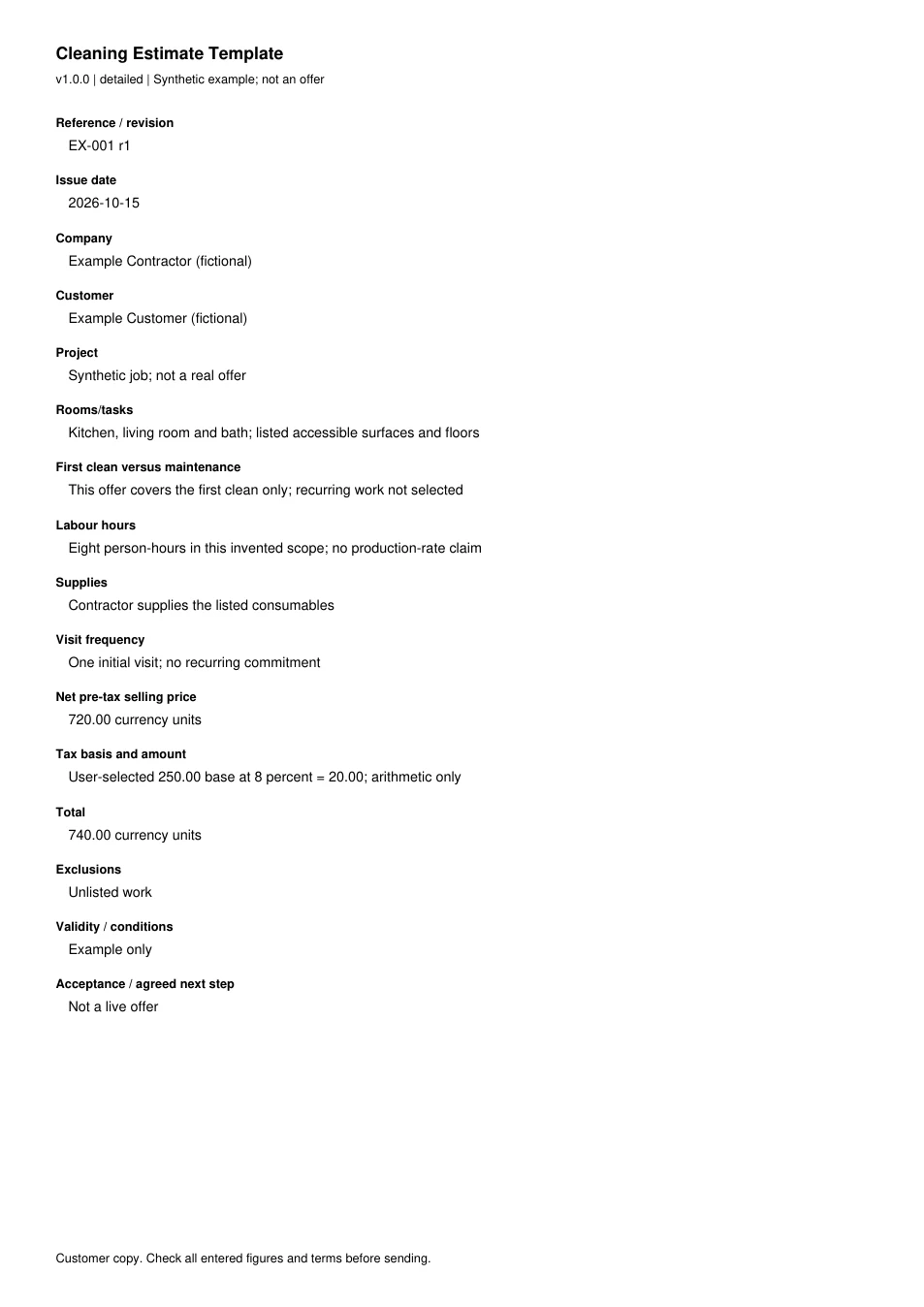
Read every field in the example
- Reference / revision
- EX-001 r1
- Issue date
- 2026-10-15
- Company
- Example Contractor (fictional)
- Customer
- Example Customer (fictional)
- Project
- Synthetic job; not a real offer
- Rooms/tasks
- Kitchen, living room and bath; listed accessible surfaces and floors
- First clean versus maintenance
- This offer covers the first clean only; recurring work not selected
- Labour hours
- Eight person-hours in this invented scope; no production-rate claim
- Supplies
- Contractor supplies the listed consumables
- Visit frequency
- One initial visit; no recurring commitment
- Net pre-tax selling price
- 720.00 currency units
- Tax basis and amount
- User-selected 250.00 base at 8 percent = 20.00; arithmetic only
- Total
- 740.00 currency units
- Exclusions
- Unlisted work
- Validity / conditions
- Example only
- Acceptance / agreed next step
- Not a live offer