
Carpet Cleaning Estimate Template (2026): Editable Worksheet and Example

On this page7
A carpet cleaning estimate template separates room area, stair work and chosen treatments. Count the real work and set out what each service includes. Do not turn a general room count into a promise that every stain or carpet condition can be restored.
List rooms and their measured carpet area. Then add stairs, furniture movement and access apart. State the cleaning scope and any treatment option. Use your own time and cost inputs. A stain-treatment line sets out the offered work, not a guarantee of complete removal or a claim about the carpet condition.
Page updated 25 October 2026. Source check dates are reported separately in the text and comparison.
Carpet Cleaning Estimate Template preview
| Trade field | Blank entry rule | Filled synthetic example |
|---|---|---|
| Rooms | Name each space | Living room and study |
| Carpet area | Measure net included area with units | Two room measurements recorded apart |
| Stairs | Count treads or use your declared billing unit | One stair flight, count to be entered |
| Treatment | Set out included or optional work | Spot treatment optional, not in base total |
| Furniture | State what will be moved and by whom | Client clears small loose items |
| Access | Record parking and entry constraints | Ground-floor entry checked |
| Visits | State the included visit basis | One service visit |
| Exclusions | List work outside the service | Carpet replacement and repairs excluded |
Scroll for more →
Room and stair scope
Measure the carpet actually included. If a room contains fixed furniture or an area outside the service, show the boundary rather than deducting it without explanation. Keep stairs in their own unit so they are not confused with room floor area.
Ask about furniture before pricing. Moving a light chair differs from moving a filled cabinet, and some items may be outside the service. Record who clears the room and how the work changes if access is not ready. Do not assume an empty-room rate covers a furnished room.
Two rooms and a stair example
A made-up client requests a living room, study and stairs. The worksheet has two measured-area lines and one stair line. A stain treatment is listed as an unselected option. It stays outside the base total until the client chooses it.
If the client adds the treatment, revise the scope and price. Keep the original sent version. Describe the treatment without promising an unverified result. Record the condition notes that limit the offer.
Cost and client checks
Keep labour, consumables and travel in the private costing. A room's area does not supply a fixed cleaning time. Use your own job basis and record what it assumes. If a return visit is included, show its scope and if the price covers one or more visits.
The client copy should show rooms, stair basis, chosen services and exclusions. Avoid private hourly costs or margin. Use a separate PDF or Word layout after checking the total. For a whole-house task list, see general cleaning.
The GAO guide supports recording scope and basis notes. It does not validate cleaning performance. Checked 15 October, with the full revision date above. No carpet chemistry, drying-time guarantee or current market rate is supplied here.
Cost two rooms and a stair flight
Use this fictional room schedule to check an area-based quote. A living room measures 15 by 12 feet, or 180 square feet. A study measures 10 by 9 feet, or 90 square feet. The included carpet area is 270 square feet.
A stair flight has 12 treads and stays in a separate count. Do not add twelve to 270 and call the result a single area.
Suppose your invented work plan allows two person-hours for the rooms, one for the stairs and half an hour for setup. At a fictional $28 cost per person-hour, the 3.5 hours cost $98. Add $16 of named consumables and $24 for the single visit's travel cost. The private base cost is $138. This is a demonstration of adding unlike cost lines after each has its own basis, not a cleaning-speed or market-price claim.
An optional spot-treatment task has half an hour of labour and $6 of consumables in this exercise. Its extra cost is $20. It remains outside the $138 base until selected. If accepted, the defined work costs $158 before any other price inputs.
Selecting treatment changes the service scope, not the measured room area. It also does not promise removal of the stain.
Record what furniture clearance covers
The room sketch should mark the carpet you can actually reach. State whether the client clears loose items before arrival and whether moving particular furniture is included. If a filled cabinet stays in place, record that service boundary. Do not deduct an unexplained area from the quote while showing the client a promise to clean the whole room.
Furniture can affect time without changing room dimensions. If the client asks you to move additional items, record the items and handling duty. Revisit the planned task time. Do not use the extra work as a reason to change all three room dimensions or to add an unlabelled surcharge.
Separate the visit from later treatment
A later return visit has its own access, travel and task basis. It is not automatically included because the first visit lists a treatment option. Name any return service you actually offer and check that the customer file reflects the same limit. Keep carpet repair and replacement outside a cleaning scope unless separately defined.
Before issuing the offer, read the room names, stair count and selected treatments together. A wrong room name can be as misleading as a wrong total. Use the common cost-field guide for the remaining selling-price inputs. Retain the room and stair schedule as this job's quantity evidence.
FAQ
How should a room-size limit appear?
If your real per-room offer has a size limit, put it beside the room price. State how a larger room is measured and priced. Do not hide the limit in a private note. Check the measured living room and study against the same rule before sending. If a space is open-plan, name its service boundary rather than guessing how many rooms it counts as. That choice belongs in the quote, not just in the cleaner's notes.
Should I price by room or area?
Use the basis that matches your real offer and label it clearly. Record the room boundaries and any size or service limits. A per-room amount and a measured-area amount are not interchangeable without a stated rule. Keep stair work and special treatments separate so the client can see what is included.
Can I guarantee every stain will disappear?
This form supplies no such guarantee. Set out the offered treatment and any known limits from the real carpet and chosen service. Do not use a made-up example as evidence of a result. Keep a condition note and resolve any unknown work before giving a final promise to the client.
Verdict on the carpet cleaning estimate template
Use the carpet cleaning estimate template to keep room areas, stairs and selected treatments distinct. Price the work you describe without promising an unverified result. The pack example checks totals, while the trade directory links broader cleaning tasks.
Inside the original file
This is the actual A4 example from the editable pack, version 1.0.0. All names, measurements, dates and amounts are invented for the form demonstration.
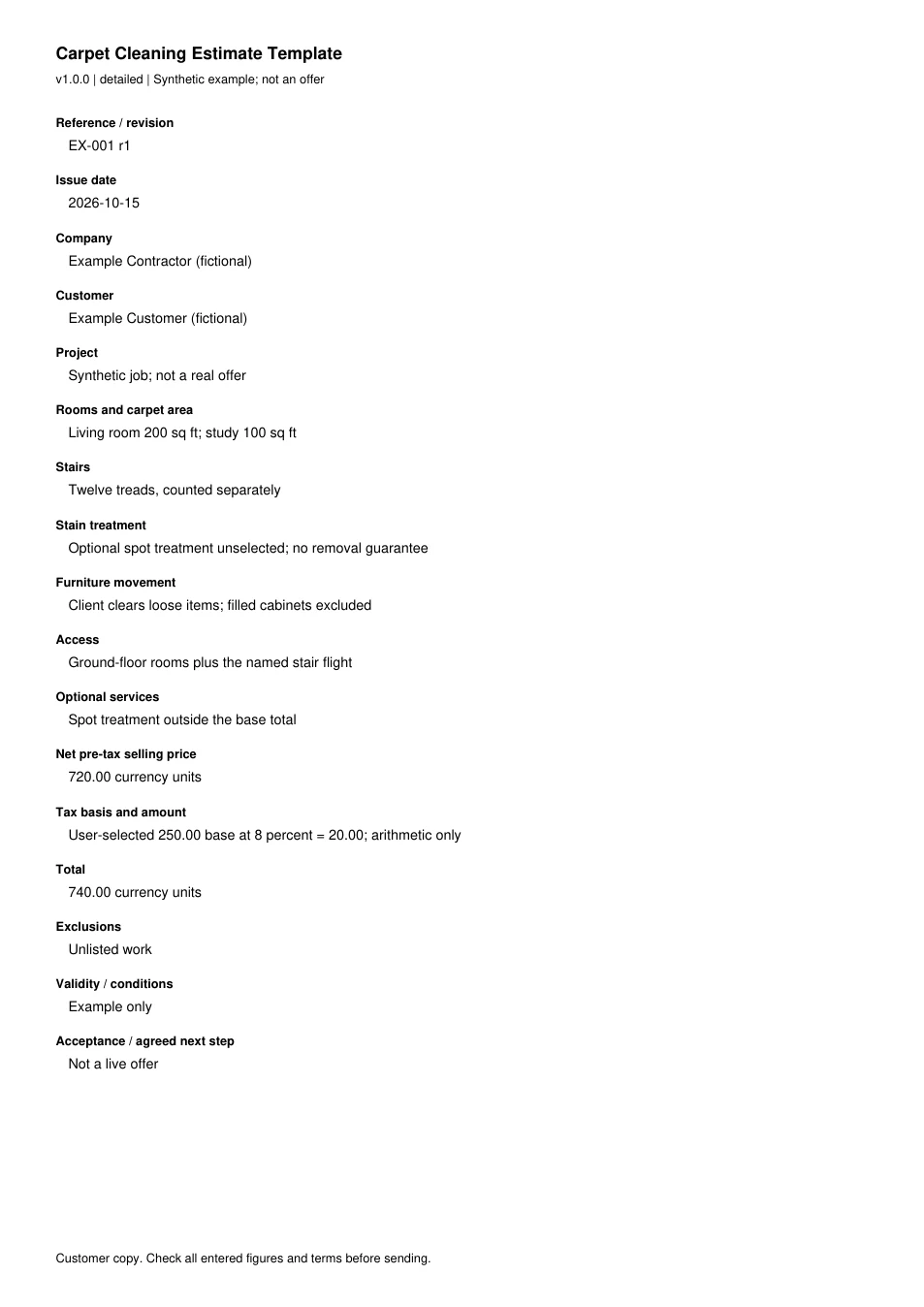
Read every field in the example
- Reference / revision
- EX-001 r1
- Issue date
- 2026-10-15
- Company
- Example Contractor (fictional)
- Customer
- Example Customer (fictional)
- Project
- Synthetic job; not a real offer
- Rooms and carpet area
- Living room 200 sq ft; study 100 sq ft
- Stairs
- Twelve treads, counted separately
- Stain treatment
- Optional spot treatment unselected; no removal guarantee
- Furniture movement
- Client clears loose items; filled cabinets excluded
- Access
- Ground-floor rooms plus the named stair flight
- Optional services
- Spot treatment outside the base total
- Net pre-tax selling price
- 720.00 currency units
- Tax basis and amount
- User-selected 250.00 base at 8 percent = 20.00; arithmetic only
- Total
- 740.00 currency units
- Exclusions
- Unlisted work
- Validity / conditions
- Example only
- Acceptance / agreed next step
- Not a live offer