
Pool Estimate Template (2026): Editable Worksheet and Example

On this page7
A pool estimate template records the service or repair you offer. Name the task and chosen parts. Pool size gives context; it does not set the price or select equipment. Keep routine visits and one-off repairs distinct.
Name the pool and record its size as context. List tasks, parts, labour, visits and exclusions. State what a visit covers and whether a repair is selected. This form does not size pumps, prescribe doses or establish safety. Keep unknown equipment and site conditions unresolved until the task is defined.
Page updated 25 October 2026. Source check dates are reported separately in the text and comparison.
Pool Estimate Template preview
| Trade field | Blank entry rule | Filled synthetic example |
|---|---|---|
| Pool record ID | Name the site or pool | Made-up residential service job |
| Size scope note | Record user details with units | Plain field only, not a sizing result |
| Service tasks | List real included actions | Defined routine visit scope |
| Parts | Use chosen item record ID | Optional replacement part, not yet chosen |
| Visits | State count and period | User-entered schedule |
| Labour | Record real task basis | Routine and repair tasks separate |
| Repair option | Keep outside included total | One separate proposed repair |
| Exclusions | State work not offered | Unlisted equipment or structural work |
Scroll for more →
Set out the service visit
Name the included tasks rather than promising “full pool service.” Record the visit frequency and any stated checks or handover. This price template gives no chemical treatment, water-quality, suction or electrical instructions. Do not imply that a price line proves a pool is safe to use.
Keep pool size as a descriptive input unless your pricing basis uses it explicitly. Size alone does not establish time, materials or equipment suitability. If a quantity or part is unknown, record the question. Do not choose a generic replacement to fill the gap.
Service with repair option
In a made-up example, the client requests routine visits and asks about a separate part replacement. The base offer lists the routine tasks and visit basis. The repair remains unselected and outside that total. Its part record ID and work scope must be resolved before acceptance.
If chosen, give the repair a clear record ID and update the offer. Do not spread its cost across recurring visits without saying that the billing basis changed. Keep one-off work and continuing service traceable in the invoice record.
Check parts and scope limits
Enter the actual chosen parts. Name who supplies and fits each one. This form does not check that a part will fit. It does not approve a substitute.
If a task is outside your service, exclude it clearly. Keep the client's copy consistent with that limit.
The cleaning worksheet shows visit and period prices. For billing, see the invoice guide. Our scope method follows the GAO guide. We checked it on 15 October. That source does not test pool performance or supply a local price.
Separate four service visits from a parts repair
This fictional routine-service plan has 1.5 person-hours for the named tasks on each visit. At an invented $28 cost per person-hour, labour is $42. Add $9 of defined consumables and $14 for travel. Private cost per visit is $65.
The inputs are made up to show a visit-based calculation. They do not prescribe treatment, work speed or any safe operating condition.
For four dated visits, the cost scenario is $260. Count the actual service dates in the period rather than assuming every month has four. If the offer bills actual visits and a fifth date is included, the comparable cost scenario is $325. A fixed monthly price needs its own agreed service terms and should not be inferred from either scenario.
The client also asks for a separately resolved parts repair. Suppose its chosen part costs $75 and the repair needs two person-hours at the same fictional rate. Repair cost is $131 before any additional travel. It remains outside the $260 routine schedule until selected. If performed during one of the planned visits with no added travel or other costs, the combined known cost is $391.
Check whether the repair needs another visit
If the repair instead needs a separate trip with the same $14 example travel basis, its cost is $145. The combined known cost becomes $405. Do not charge that trip in both the repair and routine records when it happens during an existing visit. Conversely, do not assume every future repair fits a routine visit's time or access window.
Record the actual part reference and who supplies it. A pool size note cannot select the part or validate its fit. If the item remains unchosen, the repair price remains unresolved. Do not turn $75 from this exercise into a generic allowance for any replacement component.
Keep recurring duties stable after a one-off repair
The recurring schedule should still show the agreed routine tasks. A selected one-off repair does not silently add ongoing equipment maintenance to every visit. If the client requests that change, describe its continuing tasks and rework the visit basis. Keep the repair's completion record separate from future service dates.
Read the client copy for claims the estimate cannot support. A price for routine work is not proof of water quality, equipment suitability or permission to use the pool. List only the actual service offered and its limits. Retain the task schedule and repair selection so an invoice can distinguish period service from the one-off addition.
The shared field reference explains later price inputs. Keep this pool's dated visits, part choice and travel basis with its own record; those decisions determine which costs enter the sum.
FAQ
What if the client changes the service dates?
Keep the old dates and record which visits move or leave the schedule. Check the actual billing terms before changing the period amount. A visit planned for one month is not proof it occurred in that month. Keep the repair booking separate if only the routine dates change. If access on the new dates is still open, resolve it before promising the visit. The client copy should show the accepted schedule while the service log records what actually happened at the pool.
Does the size field calculate a pump or treatment?
No. It is a plain job field. This form does not select equipment, calculate dosing or check safe operating conditions. Enter the real service and chosen parts after those needs are resolved.
Keep a trade design or treatment choice separate from the price worksheet and its made-up example.
How do I show a repair beside regular service?
Give it a separate scope and selection state. Keep it outside the routine total until accepted. Then record the changed offer and billing basis. A one-off repair should not silently alter a per-visit price.
Keep the first service schedule so the client can understand what changed.
Verdict on the pool estimate template
Use the pool estimate template to separate scheduled service from selected repair work. Resolve the actual parts and task limits before giving a complete price. The pack example checks the arithmetic; the trade directory covers other property services.
Inside the original file
This is the actual A4 example from the editable pack, version 1.0.0. All names, measurements, dates and amounts are invented for the form demonstration.
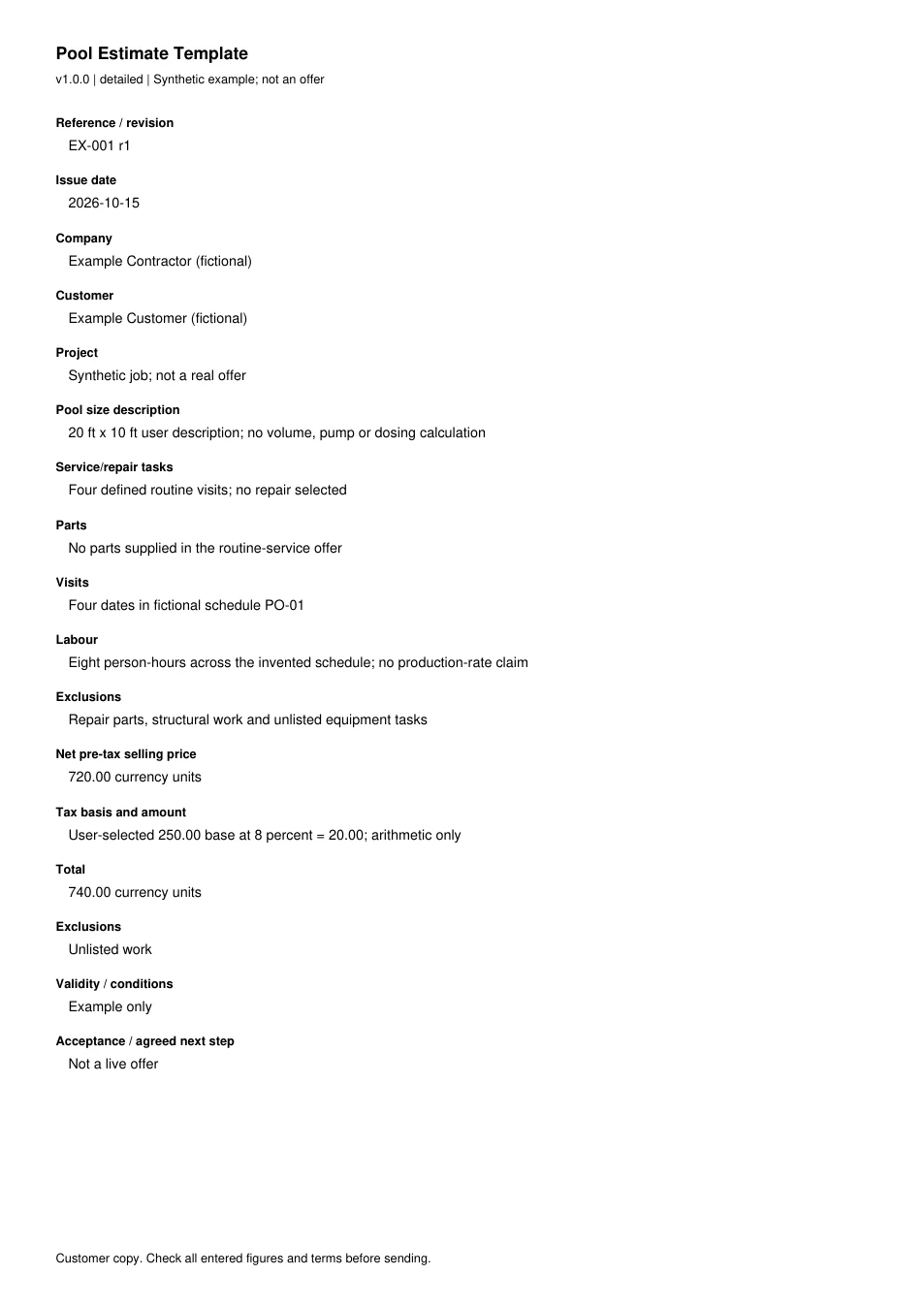
Read every field in the example
- Reference / revision
- EX-001 r1
- Issue date
- 2026-10-15
- Company
- Example Contractor (fictional)
- Customer
- Example Customer (fictional)
- Project
- Synthetic job; not a real offer
- Pool size description
- 20 ft x 10 ft user description; no volume, pump or dosing calculation
- Service/repair tasks
- Four defined routine visits; no repair selected
- Parts
- No parts supplied in the routine-service offer
- Visits
- Four dates in fictional schedule PO-01
- Labour
- Eight person-hours across the invented schedule; no production-rate claim
- Exclusions
- Repair parts, structural work and unlisted equipment tasks
- Net pre-tax selling price
- 720.00 currency units
- Tax basis and amount
- User-selected 250.00 base at 8 percent = 20.00; arithmetic only
- Total
- 740.00 currency units
- Exclusions
- Unlisted work
- Validity / conditions
- Example only
- Acceptance / agreed next step
- Not a live offer