
Pressure Washing Estimate Template (2026): Editable Worksheet and Example

On this page7
A pressure washing estimate template records surfaces, areas and work limits. Keep a driveway separate from an optional patio. Area alone does not establish a suitable method. Nor does it prove that cleaning will leave a surface undamaged.
Name each surface and its measured area. Then record preparation, access, labour, goods and water duty. Keep optional areas outside the base total. State known limits and open conditions. The form supplies no pressure setting, chemical method or performance guarantee. It organizes a defined service offer.
Page updated 25 October 2026. Source check dates are reported separately in the text and comparison.
Pressure Washing Estimate Template preview
| Trade field | Blank entry rule | Filled synthetic example |
|---|---|---|
| Surface | Identify the actual material and area | Driveway in the base scope |
| Measurement | State net included area and unit | User-measured driveway area |
| Preparation | Name included setup and work | Defined loose-item clearance |
| Access | Record working boundary and entry | Client clears the stated area |
| Labour | Use your own task-time basis | No fixed area-per-hour rate |
| Goods | Use real service inputs | User-chosen cost basis |
| Water supply | State supply and access role | Client supplies water as agreed |
| Optional area | Keep unselected work separate | Patio is outside base total |
Scroll for more →
Name the surface and boundary
Measure the real included work. A driveway label can leave edges, steps or adjacent paths unclear. Mark those boundaries so the client sees what is priced. Record the known surface condition without turning the form into a diagnosis or a safe-method instruction.
State the preparation and access needs. Name who moves vehicles or loose objects. Record who supplies water and where it is available.
Keep any unconfirmed access issue open. An area rate alone may not cover that work. Check the actual site basis before you price it.
Driveway and patio example
A made-up request covers a measured driveway. A patio is optional. Only the driveway enters the base total. The private worksheet separates labour from other inputs. The user supplies a time basis; no productivity rate is preset.
If the client selects the patio, add a new surface record. Measure its area. Check the task and time basis for that surface. It may differ from the driveway. Update the scope and revision before sending the combined price.
State what the offer promises
Set out the real service and its limits. Do not claim guaranteed stain removal or restoration from a worksheet. The chosen method must follow the real surface, product and site needs. This page does not supply trade settings or runoff instructions.
Keep private rates out of the client file. See cleaning estimates for broader task lists and window cleaning for glass. The GAO method informs scope records. It does not establish performance or local prices. Checked 15 October.
Price a driveway and test the patio option
Use this fictional boundary sketch: a rectangular driveway measures thirty by twelve feet, giving 360 square feet. An optional patio measures twelve by ten feet, giving 120 square feet. The driveway alone is the base service. Do not show 480 square feet in the included area while leaving the patio outside the price.
The made-up driveway plan has two person-hours for the stated surface work and one for setup and cleanup. At an invented $28 cost per person-hour, labour is $84. Add $18 of named goods and $22 travel. Known cost is $124 before later price inputs.
The client gives the agreed water access in this exercise. No water purchase enters the sum.
Suppose the resolved patio service adds one person-hour and $6 of goods. Its added cost is $34, taking combined known cost to $158 when selected. The task basis has been checked separately for the patio; this is not a rule that a patio always costs one third of a driveway. Different surface conditions or boundaries need their own inputs.
Avoid charging shared setup twice
In this exercise both areas are serviced during one visit, and the original setup and travel cover the combined scope. Adding another full $124 base would charge those shared tasks again. Keep the patio's extra tasks visible so the combined offer follows the actual sequence.
If the patio is booked for a later date, revisit access, setup and travel. The $34 addition no longer describes the whole second visit. State that changed visit basis before the client accepts it. A same-day option and a separate booking are different service offers even at the same area.
Resolve conditions before promising a result
Name the real surfaces and work limits on the sketch. Area math does not choose a safe pressure, product or runoff method. If the site or surface leaves the work unclear, keep that question open. The known cost sum is not yet a final price. This exercise gives no treatment settings.
Name who removes vehicles, furniture and other loose objects. Keep any unselected path, step or wall outside the included boundary. If the client adds a path, measure it separately and check the work and access basis. A new measured area should have a matching service description, not just an increased number in the total.
Use the common costing field guide after these surface and visit decisions. Keep the boundary sketch, selected patio option and shared-setup basis with the estimate so the client price can be traced to the offered work.
FAQ
How do I record a surface that is not ready?
Name the surface and the condition that leaves the task open. Keep it outside a fully priced service until the work is defined. Do not use a general stain note as a promise to remove it. If the client asks for more work, set out the new task and its limits. Check the chosen method against the real surface needs. Keep that choice separate from this form's area math. A correct area alone does not prove a sound service plan.
Can one area rate cover every surface?
Use a rate that fits the defined work. The same area can have different surfaces, condition and access. Name each surface. State the service you offer for it. This form supplies no fixed work speed or price. A single area total must not imply the same method or result on every surface.
Is the patio included with the driveway?
Only if the offer clearly includes it. Keep an unselected patio option outside the base total and name its own area and service basis. When chosen, revise the scope and amount. Do not rely on a general “exterior clean” label to explain which surfaces the client will receive.
How should I record a boundary change?
Keep the original sketch or area list. Mark the added path, step or patio on a new version. Record its own surface and measured area. Recheck access and the service scope. Then update the offer. Do not add area to the total while leaving the client with the old boundary description.
Verdict on the pressure washing estimate template
Use the pressure washing estimate template to price named surfaces and selected options. State access and water responsibilities before sending. Check the worked price for the cost sequence and the trade directory for other services.
Inside the original file
This is the actual A4 example from the editable pack, version 1.0.0. All names, measurements, dates and amounts are invented for the form demonstration.
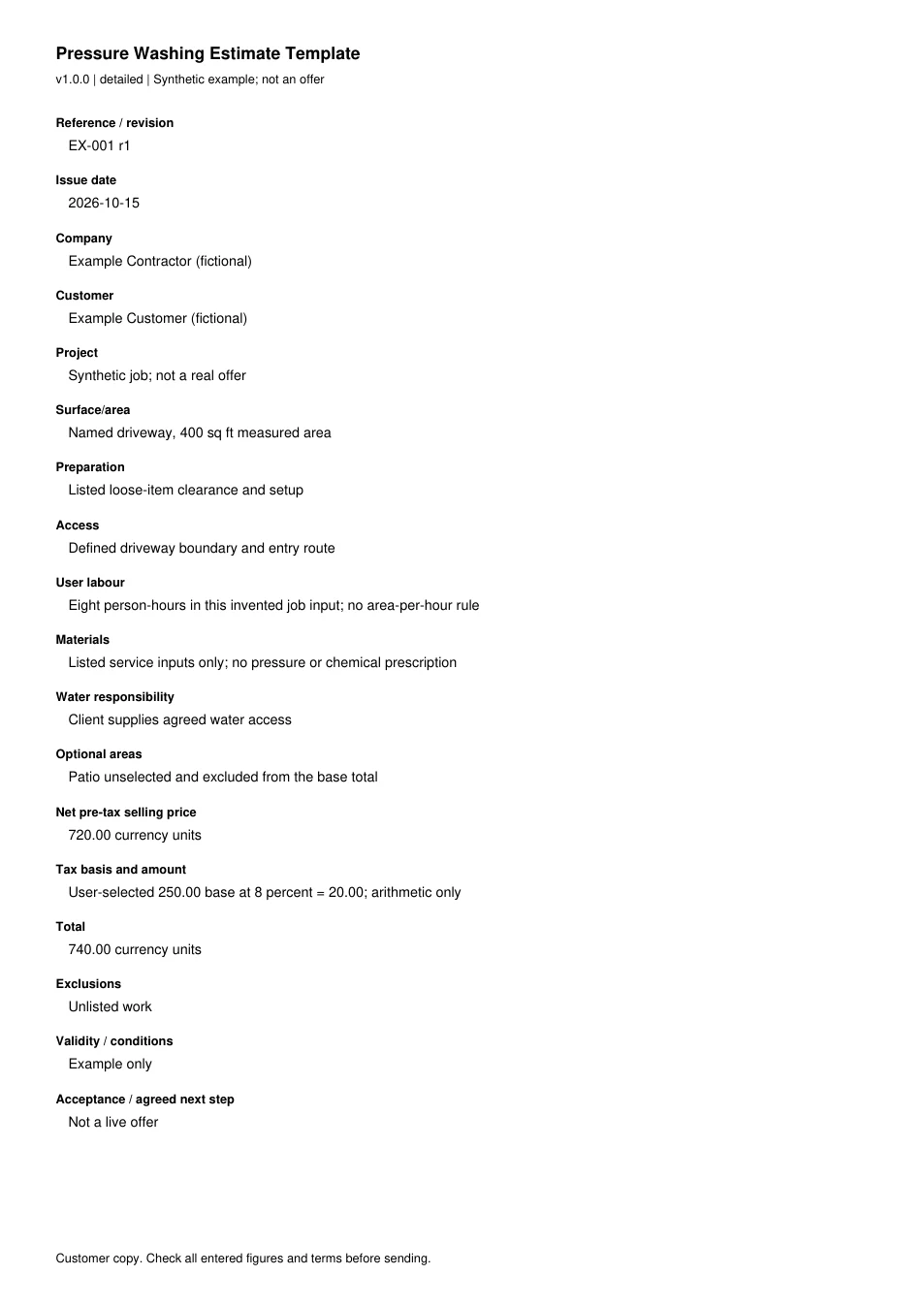
Read every field in the example
- Reference / revision
- EX-001 r1
- Issue date
- 2026-10-15
- Company
- Example Contractor (fictional)
- Customer
- Example Customer (fictional)
- Project
- Synthetic job; not a real offer
- Surface/area
- Named driveway, 400 sq ft measured area
- Preparation
- Listed loose-item clearance and setup
- Access
- Defined driveway boundary and entry route
- User labour
- Eight person-hours in this invented job input; no area-per-hour rule
- Materials
- Listed service inputs only; no pressure or chemical prescription
- Water responsibility
- Client supplies agreed water access
- Optional areas
- Patio unselected and excluded from the base total
- Net pre-tax selling price
- 720.00 currency units
- Tax basis and amount
- User-selected 250.00 base at 8 percent = 20.00; arithmetic only
- Total
- 740.00 currency units
- Exclusions
- Unlisted work
- Validity / conditions
- Example only
- Acceptance / agreed next step
- Not a live offer