
Remodeling Estimate Template (2026): Editable Worksheet and Example

On this page7
A remodeling estimate template keeps rooms, phases, selections and changes linked. Separate known work from allowances and open conditions. A phased price is useful only when the scope and milestone basis are clear enough to match.
Record room and phase scope, material quantities, labour, allowances, open questions and change references. Keep milestones tied to the client total. No deposit or market-rate default is supplied. This form records the offer. It does not validate structural design or compliance, or guarantee the condition of concealed work.
Page updated 25 October 2026. Source check dates are reported separately in the text and comparison.
Remodeling Estimate Template preview
| Trade field | Blank entry rule | Filled synthetic example |
|---|---|---|
| Room and phase | Name work by location and stage | Made-up kitchen scope |
| Goods schedule | Use real selections and units | Cabinet and finish choices recorded apart |
| Labour | Use task-based private input | Removal and fitting distinct |
| Allowance | Name item and resolution basis | Unselected finish allowance |
| Unknown work | Keep open conditions open | Concealed condition not known |
| Change record ID | Tie each agreed change to revision | CH-01 adds named scope |
| Milestones | Enter real agreed shares or amounts | Three shares must match |
| Programme | State dependencies and real basis notes | Selection date affects planned work |
Scroll for more →
Build room and phase scope
List what happens in each room and what each phase delivers. Removal, preparation, fitting and finish can have distinct work limits. Keep interfaces with other trades clear. A whole-room label does not tell a client what is being replaced, kept or excluded.
Show which selections remain open. An allowance needs a named item and price basis. State how the final choice changes the offer. Unknown work differs from an unselected finish. Record that distinction; an allowance should not make an unknown scope look fixed.
Kitchen allowance and change example
A made-up kitchen job has defined removal and fitting work, with a named finish allowance. The client later selects a distinct finish and asks for added scope. The record uses CH-01 to set out the change, its amount and the revised estimate record ID.
The first offer is kept. The new total follows the changed scope rather than replacing the old figure without explanation. If the change affects the schedule or a later milestone, record those effects too. A changed goods price alone may not tell the whole story.
Match milestones
Enter the agreed milestone basis. The pack has no default deposit. It has three percentage fields. They must add to one hundred. Only then will the stage amounts resolve.
The last stage gets any rounding remainder. This makes the schedule match the client total.
A milestone is not evidence that a stage has been completed. Keep billing and progress records tied to real events and the agreement. For payment treatment, see the invoice guide. For smaller visible tasks, use home repair.
Scope and updates follow the GAO cost guide, checked 15 October. It does not supply remodeling prices or settle trade design. Keep the real project needs beside the worksheet.
Replace an allowance without counting it twice
This fictional kitchen scope has $700 of removal cost, $450 preparation, $2400 for the selected cabinet package and $900 fitting cost. It also includes a named $300 finish-supply allowance. The known cost basis is $4750. Those are invented amounts for the listed scope, not a kitchen market-price guide. Concealed work remains a separate open issue.
Suppose the resolved finish selection costs $420 and adds $60 of fitting work. Remove the old $300 allowance, add the $420 selection and add the $60 task. Revised known cost is $4930. Adding the whole $480 to $4750 would leave the old allowance in the sum and overstate cost by $300.
Keep an allowance replacement distinct from an addition. A new $200 scope item would add $200 because no earlier line covered it. The finish change adds only $180 because its supply cost partly replaces an existing amount. Record both changes by item so the client can see why their effects differ.
Check the phase boundary after the choice
If the finish requires a later return, review travel and the work sequence. Do not assume the original fitting cost covers an extra visit. Check the actual selection and supplier timing before changing the programme. A selected finish price alone does not establish a delivery date or a guaranteed completion date.
If the client removes a cabinet run, trace the change through goods, fitting and any affected preparation. Do not reduce the total by the removed floor area's percentage. Removal, access protection and other fixed tasks may remain. Save the revised room schedule alongside the goods list so a price change has a physical scope to match.
Reconcile the client total and milestones
After resolving the remaining inputs, calculate the actual selling total separately from these private costs. As a rounding exercise only, suppose that client total is $6000.01 and the entered milestone shares are 30, 40 and 30 percent. Round the first two stage amounts to $1800.00 and $2400.00. The final stage receives the remainder, $1800.01. Together they match $6000.01.
Those shares are fictional, not recommended payment terms. If the total changes, recalculate stage amounts and apply actual payments to the correct records. Do not edit a completed payment to make it resemble the newly calculated stage. Keep billing events separate from the estimate's plan.
Use the shared pack field reference for the general cost-to-price sequence. The kitchen's phases, allowance replacement and change log explain the inputs; the stage check explains how the resulting client amount stays aligned after a revision.
FAQ
How do client-supplied cabinets change the offer?
Remove only the supply costs that leave your scope. Keep the chosen goods list and delivery duty clear. Recheck fitting, handling and any return visit caused by the supply plan. A client purchase does not make those tasks free. Nor does a cabinet count prove that every part is present. Keep any missing choice open until it is resolved. The client should see who supplies each item and which work remains in your price after the supply role changes.
Keep the old allowance visible in the change record.
Can an allowance hide an undecided scope?
It should explain the item, basis and resolution method rather than conceal the choice. Keep unselected goods distinct from unknown work. Record the real change when the choice is made and update the client offer. A general allowance does not imply unlimited work or check trade suitability.
Do milestone percentages create a deposit rule?
No. You enter the terms actually agreed for the job. The worksheet only checks that the stated shares and amounts match to the total. It does not set legal payment limits or prove work is complete.
Keep the agreement and stage records separate from the arithmetic schedule.
Verdict on the remodeling estimate template
Use the remodeling estimate template to connect phases, allowances and agreed changes. Recheck milestones whenever the customer total changes. Keep the worked calculation as a check, and use the trade directory to add task-specific scope details.
Inside the original file
This is the actual A4 example from the editable pack, version 1.0.0. All names, measurements, dates and amounts are invented for the form demonstration.
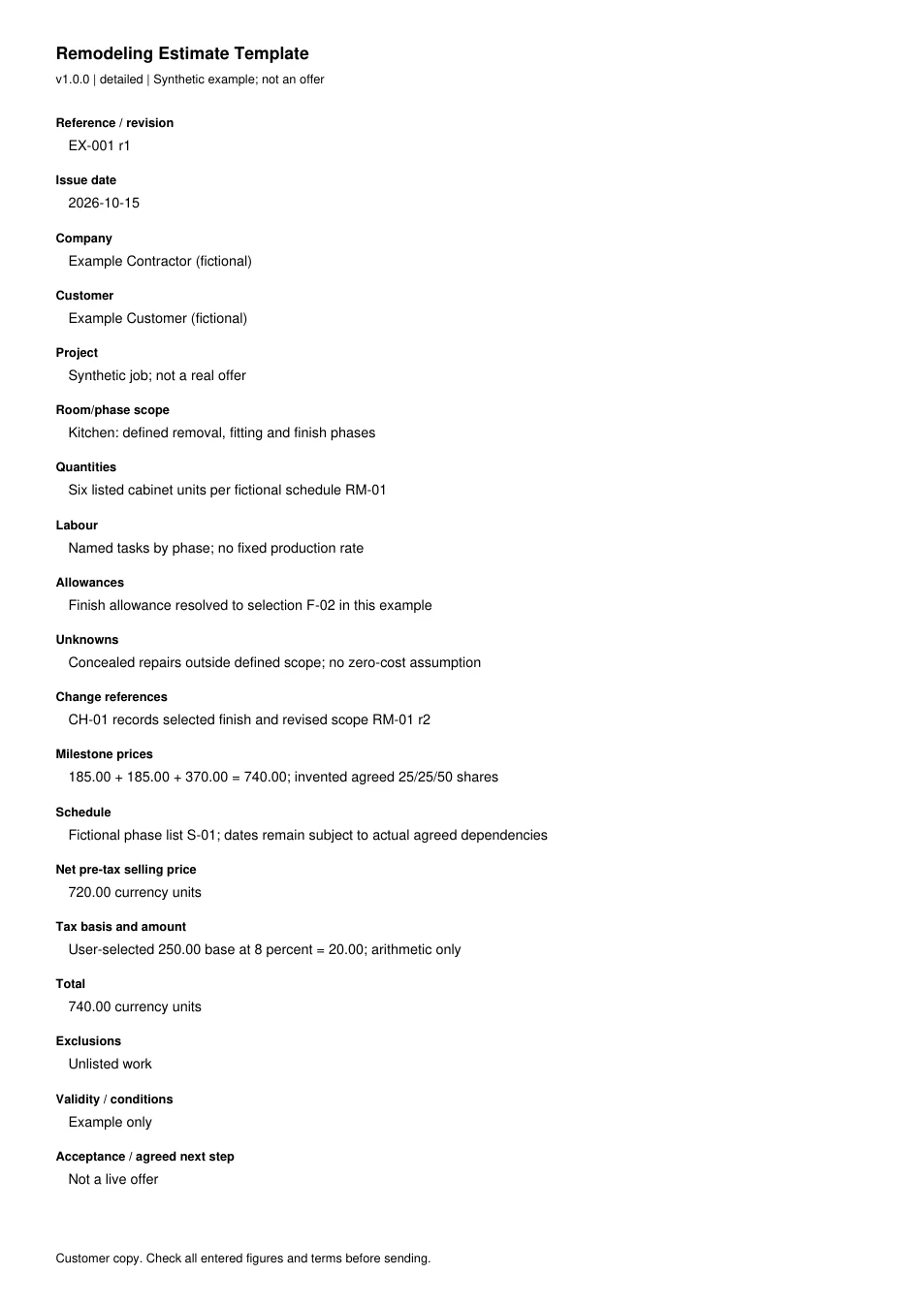
Read every field in the example
- Reference / revision
- EX-001 r1
- Issue date
- 2026-10-15
- Company
- Example Contractor (fictional)
- Customer
- Example Customer (fictional)
- Project
- Synthetic job; not a real offer
- Room/phase scope
- Kitchen: defined removal, fitting and finish phases
- Quantities
- Six listed cabinet units per fictional schedule RM-01
- Labour
- Named tasks by phase; no fixed production rate
- Allowances
- Finish allowance resolved to selection F-02 in this example
- Unknowns
- Concealed repairs outside defined scope; no zero-cost assumption
- Change references
- CH-01 records selected finish and revised scope RM-01 r2
- Milestone prices
- 185.00 + 185.00 + 370.00 = 740.00; invented agreed 25/25/50 shares
- Schedule
- Fictional phase list S-01; dates remain subject to actual agreed dependencies
- Net pre-tax selling price
- 720.00 currency units
- Tax basis and amount
- User-selected 250.00 base at 8 percent = 20.00; arithmetic only
- Total
- 740.00 currency units
- Exclusions
- Unlisted work
- Validity / conditions
- Example only
- Acceptance / agreed next step
- Not a live offer