
Home Repair Estimate Template (2026): Editable Worksheet and Example

On this page7
A home repair estimate template lists building repairs by room and task. Keep visible repairs distinct from hidden damage that is not yet known. Record materials, labour and access. The client should see what the price covers without reading private costs.
Name each building repair and its location. State known amounts, chosen goods, labour basis and exclusions. Keep concealed work open until it is defined or covered by a clear allowance and change method. This is a building-work file, not an automotive repair form, a structural diagnosis or a promise to fix every hidden condition.
Page updated 25 October 2026. Source check dates are reported separately in the text and comparison.
Home Repair Estimate Template preview
| Trade field | Blank entry rule | Filled synthetic example |
|---|---|---|
| Room or location | Name the exact work area | Entry door and adjacent trim |
| Repair task | Set out the action and limit | Adjust door and replace named trim section |
| Condition | Record known observations without diagnosis | Visible trim damage only |
| Goods | Use chosen dimensions and buy units | User-specified trim and hardware |
| Labour | Record your own task basis | Repair time separate from access work |
| Access and protection | State included setup | Protect adjacent finished surface |
| Unknowns | Keep concealed work open | Hidden frame condition not known |
| Waste and finish | State handling and final scope | Old trim removal. Paint scope as described |
Scroll for more →
Separate condition from scope
A note about visible damage is not a complete diagnosis. Record what is known and what the offer includes. If the cause or concealed extent is unclear, keep that risk clear. Do not use a generic repair line to imply that every related defect has been investigated.
Name the room, object and repair boundary. Include making good and finishing only when they are in the price. A new trim piece, surface preparation and paint can be distinct tasks. The client should not need to infer them from the word “repair.”
Door and trim example
Imagine a made-up entry-door adjustment with a short trim replacement. The base scope sets out those visible tasks and the chosen hardware. Hidden frame damage is excluded from that known scope and recorded as open rather than priced at zero.
If opening the trim reveals more work, record a change record ID. Set out the new task and pricing basis before issuing the revised offer. The first price remains traceable to its first work limit instead of being rewritten as if the extra damage had always been included.
Check handoff and finishing
State who gives access, clears the area and handles any owner-supplied goods. Record disposal and protection if included. If another trade performs the final finish, name that boundary without implying their work is part of your offer.
Keep the client copy focused on scope and checked selling amounts. The handyman worksheet handles several small tasks on a visit. The painting worksheet adds surface and coating fields. Scope method draws on the GAO guide, checked 15 October.
It does not validate a repair method or building condition.
Price a visible repair and a later concealed change
In this fictional entry repair, the known scope is a door adjustment and replacement of a named trim section. The trim takeoff needs fourteen linear feet. Suppose the chosen stock comes only in eight-foot lengths.
Two lengths supply sixteen feet. At an invented $16 per length, trim costs $32. The extra two feet are an offcut allowance, not more trim installed in the home.
The goods list also has $18 of named hardware and $12 of finish materials. The example task plan allows four person-hours for repair and two for the included preparation and finish. At a made-up $30 labour cost, those six hours cost $180. Add $25 travel and $15 waste handling. Known visible-repair cost is $282 before later price inputs.
Keep concealed damage out of the visible-repair sum
Suppose opening the trim reveals a separate bounded task. After its scope is resolved, the new goods cost $45 and the extra three person-hours cost $90. That adds $135 and makes the revised known cost $417. The new task does not retroactively become part of the first $282 scope. Keep a dated change record linked to the revised description.
If the added work affects the final finish, revisit that finish task too. Do not assume the original two-hour allowance covers a larger repaired area. Conversely, do not charge again for protection or travel that the same visit already covers. Check the actual sequence rather than adding another full visit by default.
State what the repair leaves behind
Name the repaired trim section and the included finish extent. A small repair may have a clearly limited paint boundary. If matching the whole wall is outside scope, say which surface the price covers. Record any client choice about wider finishing before changing the offer.
Keep observations distinct from conclusions about the cause of damage. The arithmetic above prices named work; it cannot establish that a moisture source or structural issue has been corrected. The shared cost-field reference covers selling-price inputs after the repair cost. Retain the trim measurement and concealed-work record as the basis for this job.
FAQ
What if matching trim is unavailable?
Keep the first selected profile in the record. Name the proposed replacement and which sections it would affect. Do not change the whole room's trim supply without changing the scope too. A wider replacement may add removal, finishing and waste even if each new length costs less. Resolve that choice before issuing a complete price. Keep a small visible repair separate from an offer to replace every matching section. The client should be able to see the finish boundary in either version.
What should the repair photos identify?
Name the room, object and visible work boundary. Keep a wide view and a detail where each helps explain the task. Add the date and link the photos to the estimate record. Do not present a close-up as proof of the condition behind a wall. If later opening changes what is known, keep the first photos and add the new evidence to the changed scope. The two sets explain why the offer changed.
Can I leave concealed damage out of the form?
Record it as an uncertainty if it may affect the work. State the known scope and any agreed allowance or change route. Do not treat an unknown amount as zero. The client needs to know what the current offer covers and what requires another decision.
Does this worksheet diagnose the cause of damage?
No. It records the repair scope and price basis you enter. It does not check structural condition, moisture cause or a suitable trade repair. Keep those conclusions tied to real project evidence and linked needs.
A made-up completed example is not a record of an inspected home.
Verdict on the home repair estimate template
Use the home repair estimate template for named repairs with stated limits. Keep concealed damage and finish responsibilities visible. The pack example checks the cost sequence; the trade directory links forms for more specific work.
Inside the original file
This is the actual A4 example from the editable pack, version 1.0.0. All names, measurements, dates and amounts are invented for the form demonstration.
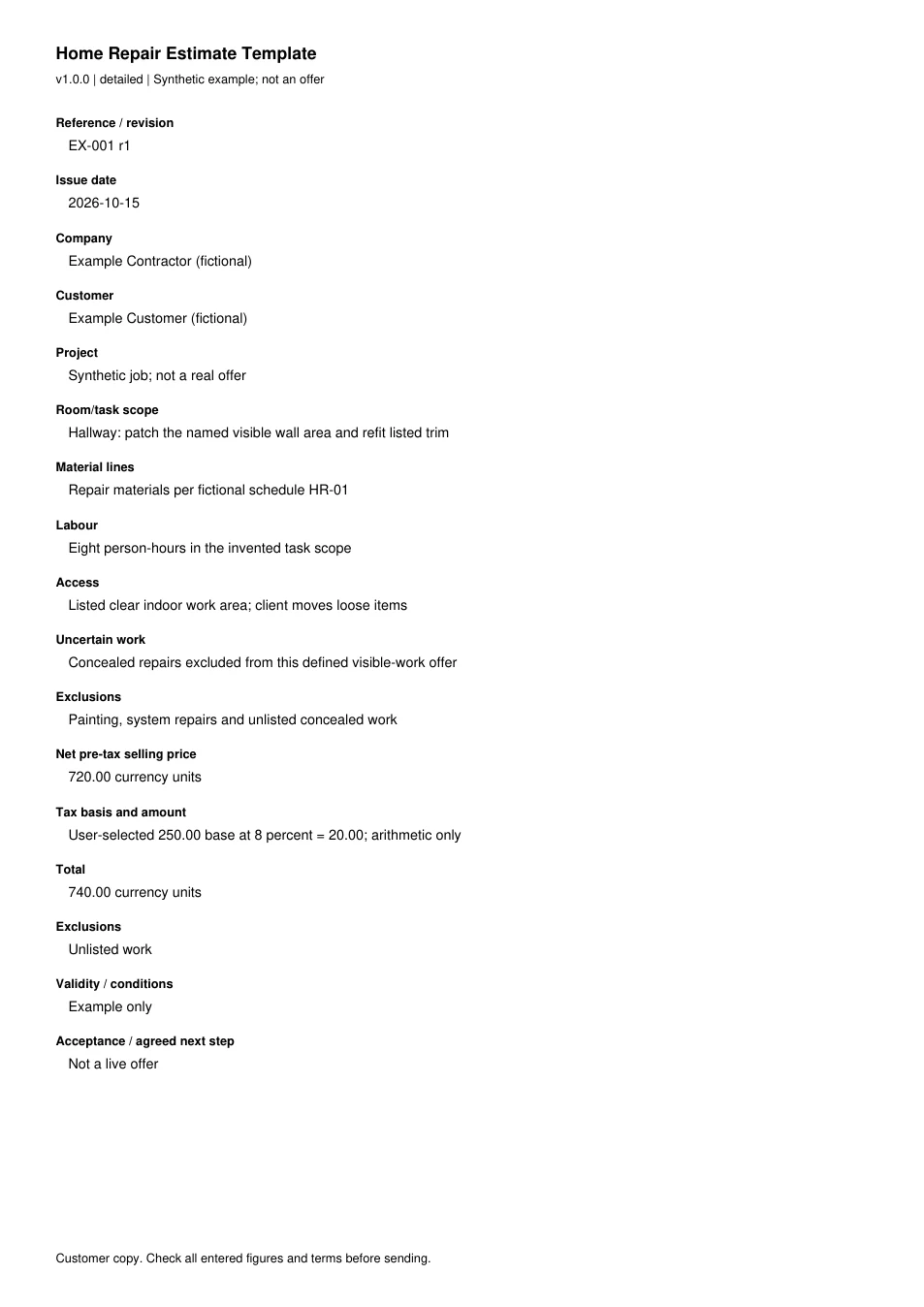
Read every field in the example
- Reference / revision
- EX-001 r1
- Issue date
- 2026-10-15
- Company
- Example Contractor (fictional)
- Customer
- Example Customer (fictional)
- Project
- Synthetic job; not a real offer
- Room/task scope
- Hallway: patch the named visible wall area and refit listed trim
- Material lines
- Repair materials per fictional schedule HR-01
- Labour
- Eight person-hours in the invented task scope
- Access
- Listed clear indoor work area; client moves loose items
- Uncertain work
- Concealed repairs excluded from this defined visible-work offer
- Exclusions
- Painting, system repairs and unlisted concealed work
- Net pre-tax selling price
- 720.00 currency units
- Tax basis and amount
- User-selected 250.00 base at 8 percent = 20.00; arithmetic only
- Total
- 740.00 currency units
- Exclusions
- Unlisted work
- Validity / conditions
- Example only
- Acceptance / agreed next step
- Not a live offer