
Handyman Estimate Template (2026): Editable Worksheet and Example

On this page7
A handyman estimate template keeps small tasks separate so one vague allowance does not swallow the whole visit. List each repair, the known goods, your time basis and any call-out or minimum charge. Make travel and exclusions visible before the client agrees.
Use one row per task with a location and a clear finish point. Record goods and labour on your own cost basis. If a minimum charge applies, show how it affects the price without adding it twice. Keep unknown damage or extra work outside a fully priced scope until it is defined.
Page updated 25 October 2026. Source check dates are reported separately in the text and comparison.
Handyman Estimate Template preview
| Trade field | Blank entry rule | Filled synthetic example |
|---|---|---|
| Task list | Name each repair and room | Adjust one door. Repair trim. Replace a shelf |
| Work limit | State the end point for each task | Door adjustment, not full replacement |
| Time | Enter your own task-hour basis | Hours recorded per task |
| Goods | Use real chosen items and units | Trim length and shelf item separate |
| Minimum charge | State real price rule | Separate disclosed minimum, no default |
| Travel | Record included or separate basis | One visit travel line |
| Unknown work | Keep uninspected damage open | Concealed wall damage open |
| Exclusions | State work not offered | Unlisted system or structural work excluded |
Scroll for more →
Make a small-job list that can be checked
A short visit can still contain several distinct tasks. Name the room and object for each one. “Fix door” could mean adjustment, hardware replacement or a new frame. State what you have actually priced and what condition remains unknown.
Keep goods separate where that helps explain the scope. A client-supplied shelf still has handling and fitting work. Record who supplies the part and what happens if it does not fit. Do not silently assume that the visit includes buying a replacement.
Three-task example
A made-up client requests a door adjustment, a trim repair and a shelf change. The worksheet uses three task lines. The cost basis records labour and goods for each. A disclosed visit minimum is then checked against the selling amount under the contractor's own rule.
The minimum is not a second charge on top unless that is the real stated offer. If it is a floor price, show the difference needed to reach it. The form supplies no default call-out amount or local market rate.
Check the boundaries
If a simple task exposes a larger issue, record the new scope and ask for a choice. Do not imply that a small repair price covers unlimited concealed work. Keep the first offer and any agreed change together.
The client file should group tasks clearly and show the visit basis. Keep private costs out. For a wider building repair, use home repair. For multiple phases, use remodeling.
The GAO guide supports scope and basis note records, checked 15 October. No trade competency or price claim follows from it.
Check a three-task visit against a price floor
This fictional visit has half an hour for a door adjustment, one hour for a defined trim repair and one hour for a shelf change. Those 2.5 person-hours at an invented $28 cost rate total $70. Goods cost $12 for the trim task and $26 for the shelf task. With $18 travel, the private cost is $126. The client supplies the existing door hardware in this example, so no new hardware purchase enters that sum.
Suppose the contractor's invented pricing rule adds 25 percent to this cost. The provisional selling amount is $157.50. A disclosed $180 visit minimum acts as a price floor.
The difference needed to reach it is $22.50; the price is $180 before any separately resolved tax. It is not $337.50. The minimum has not become another full fee added to the provisional price.
If the client adds a task that brings the provisional price to $205, that price already exceeds the floor. There is no $22.50 floor adjustment to retain. Recheck the actual rule whenever the task list changes. A floor and a separate call-out fee have different effects and must use different descriptions.
Keep procurement time visible
If the shelf is client-supplied instead, remove its $26 goods cost. Then check whether the fitting plan changes. Collecting a shelf from a shop is not part of fitting merely because both happen on the same day. State whether procurement is included and allow its time or travel only when the task plan calls for it.
The client list should identify the door, trim section and shelf location. State the finish point for each task. A door adjustment ends at the defined adjustment; it does not promise a replacement frame. The shared pack field reference explains the general price fields after you resolve this visit's tasks and minimum-charge rule.
FAQ
How do I show a minimum charge?
State the real rule and show if it is a price floor or a separate fee. Do not add a floor twice. Keep it clear in the client copy before acceptance. This worksheet supplies no recommended minimum, and the made-up example is not evidence of a local service rate.
Can a task list cover any repair?
No. The form only organizes work you actually offer and have defined. It does not check qualifications, trade suitability or a right to perform regulated work. Keep uninspected conditions open and give larger changes their own scope record ID.
Do not let a broad task label imply unlimited repair work.
Verdict on the handyman estimate template
Use the handyman estimate template to give each small task a clear finish point. State the minimum-charge rule without counting it twice. Review the price example, then use the trade directory when a task needs more detail.
Inside the original file
This is the actual A4 example from the editable pack, version 1.0.0. All names, measurements, dates and amounts are invented for the form demonstration.
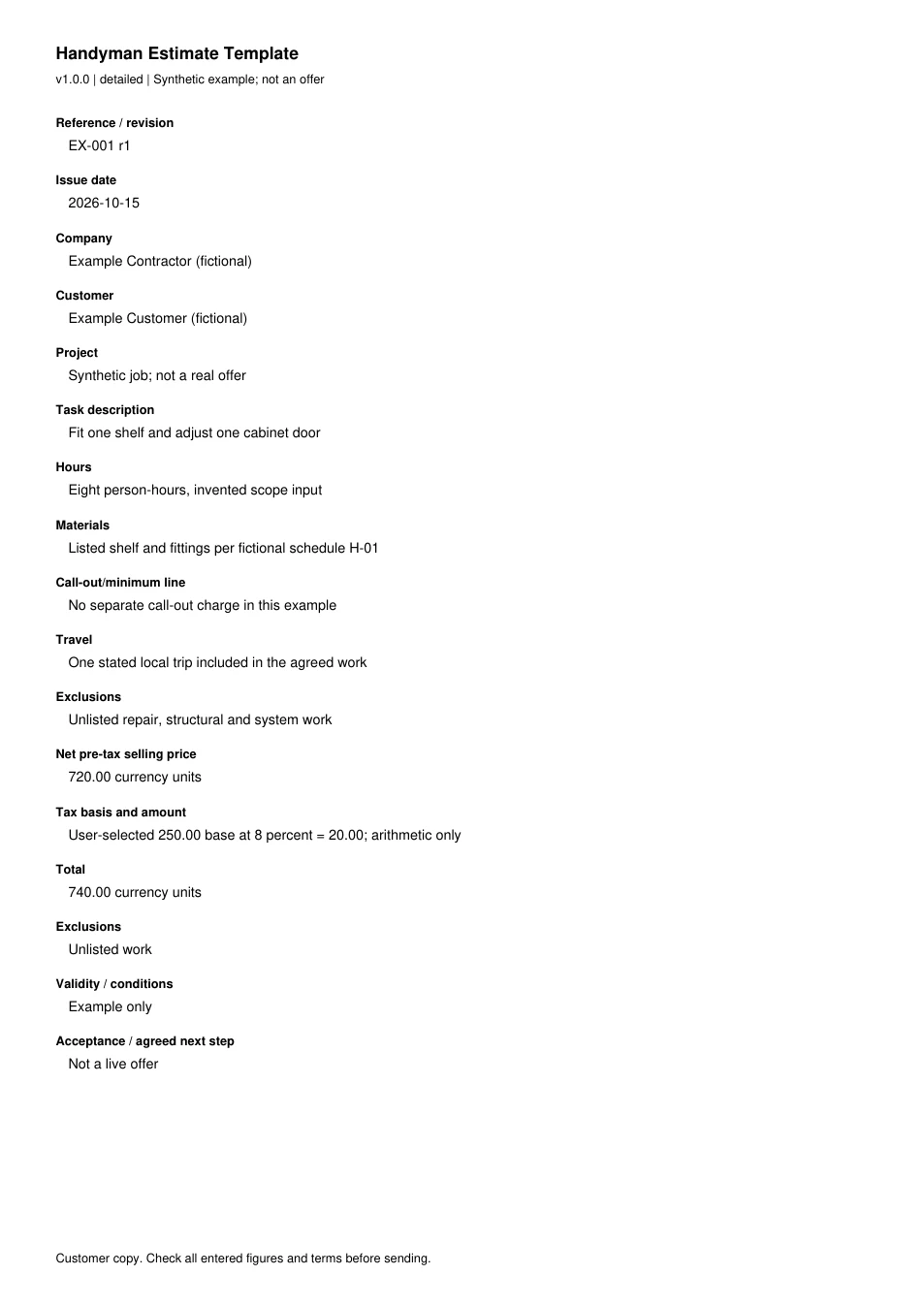
Read every field in the example
- Reference / revision
- EX-001 r1
- Issue date
- 2026-10-15
- Company
- Example Contractor (fictional)
- Customer
- Example Customer (fictional)
- Project
- Synthetic job; not a real offer
- Task description
- Fit one shelf and adjust one cabinet door
- Hours
- Eight person-hours, invented scope input
- Materials
- Listed shelf and fittings per fictional schedule H-01
- Call-out/minimum line
- No separate call-out charge in this example
- Travel
- One stated local trip included in the agreed work
- Exclusions
- Unlisted repair, structural and system work
- Net pre-tax selling price
- 720.00 currency units
- Tax basis and amount
- User-selected 250.00 base at 8 percent = 20.00; arithmetic only
- Total
- 740.00 currency units
- Exclusions
- Unlisted work
- Validity / conditions
- Example only
- Acceptance / agreed next step
- Not a live offer