
Painting Estimate Template (2026): Editable Worksheet and Example
On this page9
A painting estimate template links surfaces, preparation and coats to the chosen coating details. Keep measured area separate from purchased paint. A single area rate does not explain if ceilings, trim, repairs or a second finish are included.
Measure included surfaces, record deductions and state preparation and coat count. Use the selected product's coverage for the actual surface and your own waste assumption. Paint quantity equals net area times coats divided by coverage before purchase rounding. This equation checks units; it does not guarantee coverage or replace product instructions.
Page updated 25 October 2026. Source check dates are reported separately in the text and comparison.
Painting Estimate Template preview
| Trade field | Blank entry rule | Filled synthetic example |
|---|---|---|
| Surface schedule | List walls, ceilings, trim and exterior parts apart | Interior walls and one exterior surface |
| Gross area | Use measured dimensions and units | Each rectangle recorded on the takeoff |
| Deductions | State which openings leave the measured scope | User-defined opening deductions |
| Preparation | Set out repairs and surface work | Named patch and preparation scope |
| Product | Use the real chosen spec | No brand or fixed coating chosen |
| Coats | Enter real specified count | Two coats only in the synthetic example |
| Coverage | Use a product- and surface-specific basis | Hypothetical 400 sq ft per gallon example |
| Waste | Record user basis note apart | No default waste percent |
| Buy unit | State container unit and rounding | Gallons or stated container size |
| Labour | Keep preparation and coating tasks visible | User task-time basis |
Scroll for more →
Measure the surfaces you include
A rectangular wall area is length times height. Keep each wall in the schedule. Add a ceiling only if it is in scope. Trim may use a distinct measurement or task basis.
So do not bury it in wall area without saying how it was priced.
Record deductions rather than using a hidden rule. A window opening may leave the net wall area, while its frame or trim may still need work. The worksheet should show which surface each amount sets out. Keep the source sketch with the estimate revision.
Work through paint amount
This made-up example has 1200 square feet of net surface and two coats. Hypothetical coverage is 400 square feet per gallon per coat. Multiply 1200 by two, then divide by 400. The result is six gallons before waste. These invented inputs check units; they are not a real product's coverage.
If the chosen product's stated coverage is a range, do not silently use its highest value as a guarantee. Choose and record the real estimating basis for the surface and work. Review product instructions for the chosen coating. No fixed coverage or waste percent is supplied by this template.
Round when you convert the required paint volume to the purchase unit. The liquid volume and the number of containers are separate values. Keep leftover paint distinct from the area actually coated. Buying a full container does not add more surface area to the client scope.
Interior room example
The made-up interior job includes named walls with a stated finish. Ceiling and trim are separate choices. Preparation has its own work limit, including the listed small repairs. The worksheet keeps preparation time, coating time and paint supply distinct.
If the client adds the ceiling, update its area and coating basis. If they change the finish or product, check the goods and labour basis notes again. Do not change only the final total while leaving the old scope in the client copy.
Exterior surface example
A separate made-up exterior task covers one defined surface. Its preparation and access basis notes differ from the room example. Keep those facts in the worksheet rather than using the same indoor time basis. This page gives no ladder, scaffold, lead-paint or coating-removal instructions.
If existing coating or condition is unknown, record the issue before promising a complete price. A general preparation line cannot check that a surface is ready. Resolve specialist or regulated work under the real project needs instead of using a template basis note.
Scope review before the price
| Question | What the offer should state |
|---|---|
| Which surfaces? | Name the rooms, elevations or individual parts. Keep walls, ceilings and trim distinct enough that the client can see their choices. A whole-room label is not a measurement record. |
| Which preparation? | Define the included cleaning, patching or other surface task without implying unlimited repair. If the condition is unknown, keep that risk and the agreed resolution method. |
| Which coating basis? | Name the real chosen finish and product spec. A template must not substitute a generic coverage number for the chosen goods and its instructions. |
| How many coats? | State the project need and how it relates to the included work. Do not promise a result from a hypothetical example count. Recheck amount if the coat spec changes. |
| Which access and protection? | Record included setup and the real working basis notes. A cost allowance does not validate safe access or a trade method. Keep those roles tied to the real job. |
| Which excluded work? | Name unselected surfaces, repairs or specialist treatment outside the price. Check that the exclusions agree with the scope schedule and the client-facing total. |
| What handover? | State cleanup and any goods handover included in the offer. Do not imply an unlimited return visit or performance guarantee from a generic completion line. |
Scroll for more →
The GAO guide supports amount and basis note records. Microsoft ROUND supports the currency rule. Checked 15 October. Neither source supplies coating coverage or a market rate.
The amount equation is checked by cancelling square feet and coats against the user-entered coverage unit.
For board and finish boundaries, see drywall estimates. For wider phase changes, use remodeling.
Cost the paint order separately from coating time
Continue the made-up wall example above. Its 1200 square feet need two coats. At the invented coverage of 400 square feet per gallon, that uses six gallons before waste.
Suppose the user adds ten percent for planned waste. Required volume becomes 6.6 gallons. Here the chosen colour comes in one-gallon cans, so the order rounds up to seven. These inputs do not set the needs of a real paint job.
At a made-up $36 per can, paint costs $252. Add $48 for the named masking and prep goods.
The private plan has eight person-hours of prep and sixteen for the stated coating tasks. At a made-up $29 cost per person-hour, those 24 hours cost $696. Add $40 for the stated access setup and $35 travel. Known cost is $1071 before other price inputs.
The cost check is 252 plus 48 plus 696 plus 40 plus 35. Keep the preparation and coating hours separate. A revised surface condition may alter preparation while the coat count stays the same. A new colour or finish may alter the goods and coating basis without changing the room dimensions.
Check an added ceiling on its own basis
Suppose the client adds a 200-square-foot ceiling with two coats. Using the same fictional coverage only for this calculation, volume is one gallon before the user allowance. With ten percent added, required volume is 1.1 gallons. If it is a different product or colour sold in one-gallon units, order two containers. Do not merge that 1.1 gallons with the wall order and assume one shared container can serve both selections.
If the ceiling uses exactly the same selected goods, review whether the combined order can share a purchase unit. Keep the measured ceiling and its task time separate even if the supply order combines. The container decision affects purchased goods, not which surface the client receives.
Keep repairs and finish promises measurable
List the patches and surface preparation actually included. If opening a crack reveals work beyond those limits, define the changed repair before adding time. Avoid a general “prep included” label beside a fixed price that covers only the named small tasks.
Read the final scope by surface: walls, ceiling and trim. Match each selected product, coat count and finish boundary to its priced task. Keep optional exterior work outside an interior total. The shared costing definitions explain the later selling-price calculation; this surface and container schedule explains the painting quantities. Neither the example coverage nor its hours proves a real coating result.
FAQ
Keep the final colour and product choices beside the container order. Separate leftover goods from the measured surfaces and from any later touch-up service commitment.
Can one coverage number suit every surface?
No. Follow the chosen product's instructions for the actual surface. A stated range does not guarantee its highest coverage value on your job. Record the coverage you use and your own waste allowance.
The synthetic example checks units only and does not check performance for a real coating or surface.
Should paint and labour be one line?
You may present one agreed selling amount in the client copy. Keep quantities and task costs clear in private records. Preparation, coating and supply can change independently. Separate them in the costing so a changed product or scope can be checked against the original price build-up.
Verdict on the painting estimate template
Use the painting estimate template to trace surfaces, preparation, coats and purchase units. Keep product coverage tied to its actual basis. The worked estimate checks selling amounts, and the trade directory links board and repair scopes.
Inside the original file
This is the actual A4 example from the editable pack, version 1.0.0. All names, measurements, dates and amounts are invented for the form demonstration.
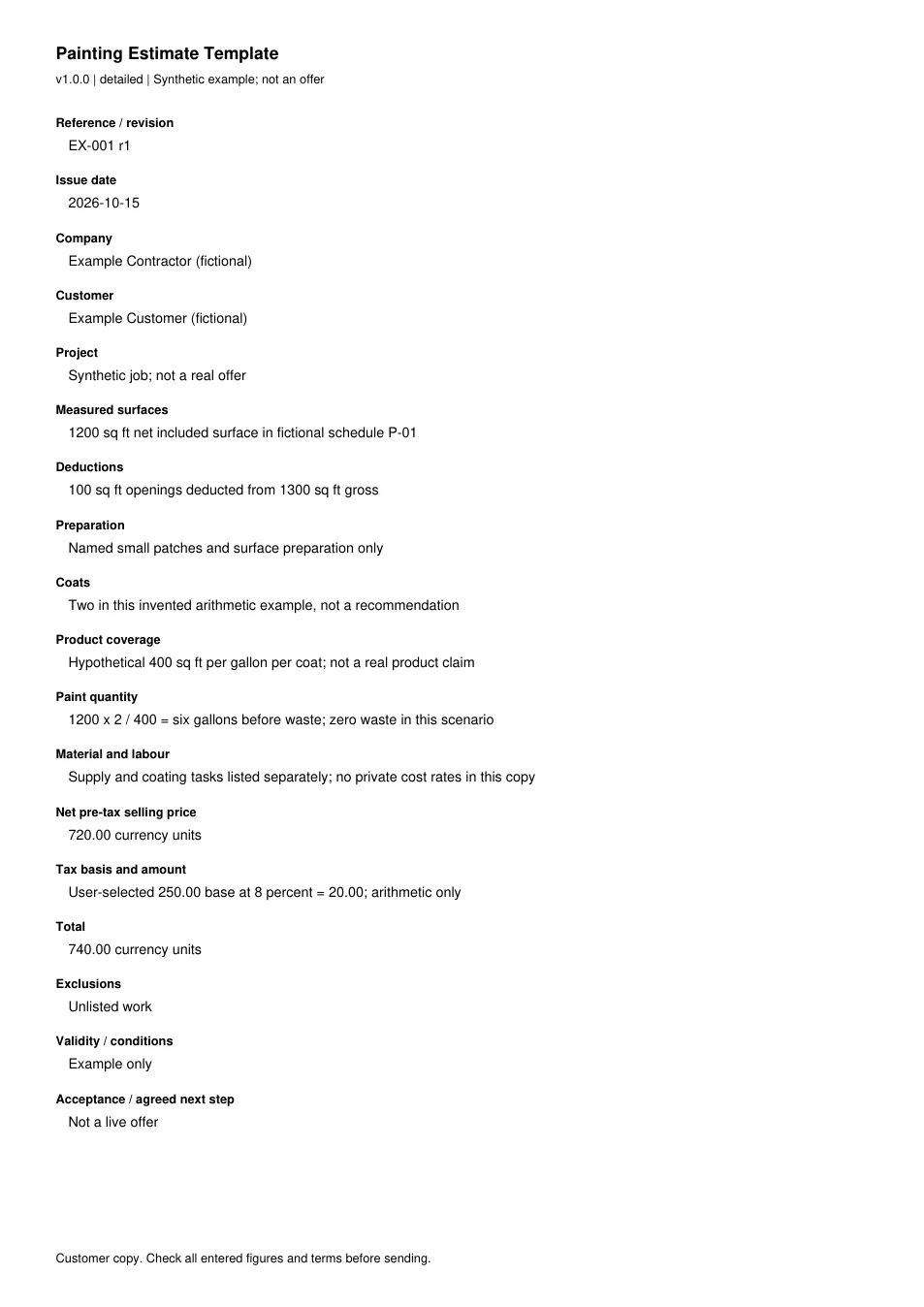
Read every field in the example
- Reference / revision
- EX-001 r1
- Issue date
- 2026-10-15
- Company
- Example Contractor (fictional)
- Customer
- Example Customer (fictional)
- Project
- Synthetic job; not a real offer
- Measured surfaces
- 1200 sq ft net included surface in fictional schedule P-01
- Deductions
- 100 sq ft openings deducted from 1300 sq ft gross
- Preparation
- Named small patches and surface preparation only
- Coats
- Two in this invented arithmetic example, not a recommendation
- Product coverage
- Hypothetical 400 sq ft per gallon per coat; not a real product claim
- Paint quantity
- 1200 x 2 / 400 = six gallons before waste; zero waste in this scenario
- Material and labour
- Supply and coating tasks listed separately; no private cost rates in this copy
- Net pre-tax selling price
- 720.00 currency units
- Tax basis and amount
- User-selected 250.00 base at 8 percent = 20.00; arithmetic only
- Total
- 740.00 currency units
- Exclusions
- Unlisted work
- Validity / conditions
- Example only
- Acceptance / agreed next step
- Not a live offer