
Plumbing Estimate Template (2026): Editable Worksheet and Example

On this page7
A plumbing estimate template distinguishes service work from a new installation. Name fixtures, parts, access and the priced work limit. Fixture count alone does not establish pipe sizing, compliance or concealed conditions.
Record fixtures and pipe quantities with units. Name selected parts, service or installation tasks, access and removal. State the acceptance route. Keep unknown conditions unresolved. This form does not design a plumbing system or give installation steps. The offer records scope and exclusions; it does not certify an unobserved result.
Page updated 25 October 2026. Source check dates are reported separately in the text and comparison.
Plumbing Estimate Template preview
| Trade field | Blank entry rule | Filled synthetic example |
|---|---|---|
| Fixture record ID | Name real type and location | One fixture replacement in the example |
| Parts | Use chosen spec and supply role | Contractor-supplied named parts |
| Pipe amount | State measured length and unit if included | No hidden length assumed |
| Service task | Set out the work limit | Defined replacement, not all system repairs |
| Access | State opening and making-good scope | Access allowance open |
| Removal | Name old parts and disposal | Listed fixture removal |
| Testing and handover | Reference the actual requirements | No technical certificate implied |
| Acceptance | State the next client step | Review the named scope and price |
Scroll for more →
Match scope to the real task
A request to replace a fixture needs a location and a chosen item. Name who supplies it. List the connection work and any other included tasks. If the existing condition is unknown, say so. Keep that issue open before you describe the price as complete.
Keep measured pipe or other goods separate from counted fixtures. Label the unit on both amount and rate. This worksheet does not infer a pipe size, pressure need or system capacity from a fixture count. Those choices belong to the real project needs.
Fixture replacement example
A made-up job replaces one chosen fixture. Parts, labour and old-fixture removal have separate cost lines. Access work is an open allowance because the concealed route is not yet known. The client scope names that risk rather than treating it as free work.
Once the access task is defined, update the scope and amount. Keep making good and any finish work clear. A plumbing price does not on its own include repainting or broader building repair unless the offer states it.
Check the outgoing scope
Record the chosen item and supply role in the client copy. Keep buy prices and margin private. Any needed test or handover record has a separate purpose. The estimate itself does not certify the work.
Do not set out a made-up example as a completed service job.
Use home repair for adjacent building tasks. The estimating guide explains the cost sequence. Our scope records follow the GAO guide, checked on 15 October. That source does not set a local price. This worksheet does not design the system or certify that the work meets local rules.
Cost one selected fixture without pricing unseen access
This made-up job uses a chosen fixture that costs $160 and named parts that cost $24. Three person-hours at an invented $34 cost rate adds $102 of labour. Add $20 to remove the old fixture and $25 travel. Known cost is $331. That sum has no hidden pipe work or wall repair in it.
If access is unresolved, label $331 as the known-scope cost rather than a complete final job amount. A fixture count cannot fill the missing access field. Keep the actual project requirements beside the offer until the work boundary is known.
Price a resolved access change
Suppose the access scope is later defined and adds two person-hours and $18 of named goods. At the same fictional rate, the addition costs $86. Revised known cost is $417. A different contractor handles the separately described finish in this exercise, so that finish remains outside the plumbing amount. The client scope must name that boundary plainly.
If the client supplies the fixture instead, remove its $160 purchase cost. Keep the selected item reference and supply duty. Check whether collection, handling or fitting work changes; do not assume removing the purchase line removes all work involving the fixture. A client-supplied item also does not establish compatibility.
Read the service limit back to the client
Identify the fixture location and the defined replacement. State what happens to the old item and which access and finish tasks are included. Keep broader system repair outside the scope unless it is separately resolved. A price line cannot prove that a required test happened or certify the completed work.
Use the pack cost-field guide for general selling-price inputs. Retain the selected fixture, parts list and access change as this job's evidence; no pipe-sizing or installation instruction is implied by the arithmetic.
FAQ
How should a fixture bundle be counted?
Read the chosen supplier's goods list. Note which parts come with the fixture and which must be bought apart. Do not charge for the same supplied part in both a bundle and a loose-goods line. Keep the part on the scope list even when it has no separate purchase line. Check fitting time on its own basis. A part in a box is not proof that all related work has been priced.
If the client changes the fixture, compare the two goods lists before reusing the parts amount. A new choice may change what comes in the box. Save the old quote and note what the new one adds or removes. Keep the client offer tied to the chosen fixture so it does not describe one item and price another.
What if a second visit is needed?
State why the work needs a return and which tasks happen then. Check extra travel and access costs rather than adding the whole first-visit amount again. Keep tasks already covered in the first visit out of the new sum. Record who makes the site ready for the return. The offer should show the agreed visit basis and any open date. Do not promise a finish date while a required part or access choice remains unknown.
Does a fixture count supply the total price?
No. The chosen item, real service task, access, parts and work limits affect the scope. Record your own cost basis and leave unknown conditions open. The form does not decide trade sizing or assume that every fixture replacement needs the same work.
Keep the priced task tied to the real project.
Is making good included?
Only when the offer describes it. Record who handles opening, closing, patching and finishing. If another trade handles the finish, name that boundary. A general replacement label should not imply unlimited building repair.
Update the scope if access conditions change the work.
Verdict on the plumbing estimate template
Use the plumbing estimate template for a defined service or installation offer. Keep access and making-good work explicit. Check the price sequence before copying selling amounts into the client file, and use the trade directory for adjacent work.
Inside the original file
This is the actual A4 example from the editable pack, version 1.0.0. All names, measurements, dates and amounts are invented for the form demonstration.
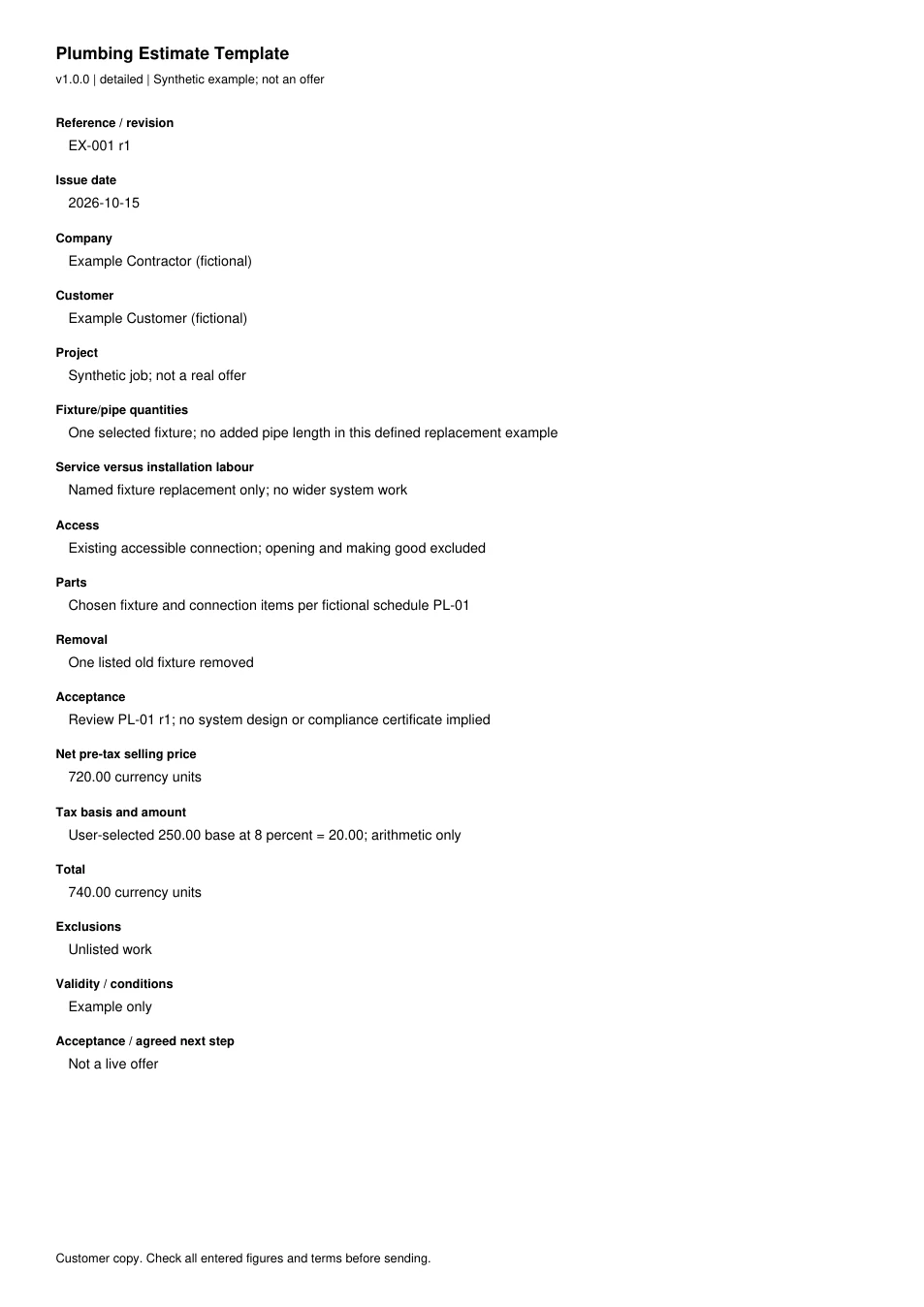
Read every field in the example
- Reference / revision
- EX-001 r1
- Issue date
- 2026-10-15
- Company
- Example Contractor (fictional)
- Customer
- Example Customer (fictional)
- Project
- Synthetic job; not a real offer
- Fixture/pipe quantities
- One selected fixture; no added pipe length in this defined replacement example
- Service versus installation labour
- Named fixture replacement only; no wider system work
- Access
- Existing accessible connection; opening and making good excluded
- Parts
- Chosen fixture and connection items per fictional schedule PL-01
- Removal
- One listed old fixture removed
- Acceptance
- Review PL-01 r1; no system design or compliance certificate implied
- Net pre-tax selling price
- 720.00 currency units
- Tax basis and amount
- User-selected 250.00 base at 8 percent = 20.00; arithmetic only
- Total
- 740.00 currency units
- Exclusions
- Unlisted work
- Validity / conditions
- Example only
- Acceptance / agreed next step
- Not a live offer