
HVAC Estimate Template (2026): Editable Worksheet and Example

On this page10
An HVAC estimate template records the equipment and work offered. List supply, accessories, labour and removal separately. Keep unknown permit costs unresolved. Use the form to explain a price; it does not size heating or cooling equipment.
Name the actual equipment model and quantity. List accessories, installation or service tasks, removal and controls. State who handles permits. Keep unknown costs unresolved. This form does not infer capacity, refrigerant charge, electrical requirements or efficiency. The offer records the selected work; it does not validate the system design.
Page updated 25 October 2026. Source check dates are reported separately in the text and comparison.
HVAC Estimate Template preview
| Trade field | Blank entry rule | Filled synthetic example |
|---|---|---|
| Equipment record ID | Enter real chosen model and variant | User-chosen record ID, not an invented product |
| Amount | State units supplied | One replacement unit in the made-up scope |
| Accessories | List included items | Mounting and other chosen items apart |
| Controls | State included control work | Existing control compatibility open |
| Labour | Separate install work from service work | Named replacement task |
| Removal | State old-equipment handling | Removal line with stated limit |
| Permits | Name duty and real amount if known | Unknown amount remains open |
| Commissioning/handover | Reference the required scope records | Actual project requirements; an invoice is not a certificate |
| Acceptance | State next step and version | Client reviews the named offer |
Scroll for more →
Start from an actual equipment selection
Record the exact model from the actual proposal or project files. Do not guess capacity or electrical supply from a room label. The form cannot establish whether a unit suits a building.
Keep the unit and its accessories on separate lines. List controls and mounting items too. State what the unit price covers. The client needs that detail to compare offers. Do not invent a model or price to fill a blank field.
Equipment replacement example
The made-up example covers a selected replacement unit with separately listed accessories. Labour and old-equipment removal have their own scope. The permit amount is unknown. It stays unresolved; the example does not claim a complete final price.
If the chosen unit changes, check its accessories and connections. Update the scope and costs before the total. Keep the old revision. A cheaper model may have a different scope. This form cannot approve a substitute.
Service and install work are distinct tasks
A service visit may cover a check or repair. It need not include a new system. A replacement may have several stages and links to other work. Name the task you offer. State where that work ends.
Do not blend all work under an undefined “HVAC complete” line.
Name each allowance and how its final amount will be set. If an item is excluded, name the responsible party where known. Check the whole scope for conflicts. The same control or interface must not be included in one section and excluded in another.
Interface review schedule
| Topic | Price question to resolve | Evidence to keep |
|---|---|---|
| Existing system | What is removed, kept or altered under this offer? Keep unverified condition separate from the priced task. | Real site and project notes with a date. No made-up inspection claim. |
| Equipment identity | Which exact variant and amount does the seller supply? A family name alone can hide distinct configurations. | The real chosen equipment schedule and vendor record ID. |
| Accessories | Which mounting, connection and other named items are included? Do not assume every accessory is in a unit line. | Item list tied to the chosen project scope and price revision. |
| Controls | What control supply, connection or alteration is included, and what remains open? | The real interface need and scope duty record. |
| Other trades | Who gives associated work, and where does this offer stop? Keep price boundaries clear without supplying trade instructions. | Named work limits in the proposal and any linked package record IDs. |
| Access | What site access, delivery and working-window basis notes affect the offer? Do not imply safe access has been known by a cost line. | The real access plan or recorded conditions used to prepare the price. |
| Removal | What old equipment and waste handling are included? Keep removal distinct from any unlisted remediation or hazardous-material work. | The listed removal scope and actual receiving or handling basis. |
| Permits | Who obtains required approvals and how are their costs treated? An unknown fee is not zero. | The actual requirement, responsible party and dated fee basis when known. |
| Handover | Which completion, testing or operating records are in the scope? The offer itself is not the trade completion record. | The project's needed file list and who supplies each item. |
| Exclusions | Which associated tasks are outside this price? Check that exclusions agree with the included scope elsewhere. | One consistent exclusions list checked against the work schedule. |
| Programme | Which dates are requested and which depend on supply or client choices? Do not invent a guaranteed start. | Vendor and client timing basis notes with their real status. |
| Revision | What changed when equipment or scope changed? Keep the prior sent offer and connect the new figure to the new work. | Estimate record ID, revision, date and a short change reason. |
Scroll for more →
Make a client-only output
Copy checked selling amounts into a new client file. Keep supplier costs, labour costs and margin private. Show the equipment model, scope and exclusions. State how the client should respond. Reopen the outgoing file and check the model reference against the selected offer.
Use the estimate example for arithmetic. Use home repair for non-system building tasks. The remodeling worksheet keeps phase changes and milestones separate.
The GAO cost guide supports clear scope and cost records. We checked it on 15 October. It does not validate an HVAC design or quoted price. This page does not certify trade work or local compliance. It gives no gas, refrigerant or electrical fitting steps.
Check a model change before repricing
Use a fictional equipment cost of $2400, $180 of named accessories, sixteen person-hours at a made-up $35 cost rate, $140 removal and $90 delivery. Known cost is $3370. The permit fee remains unknown, so $3370 is not a complete job price. This exercise supplies no equipment model, capacity or installation method.
Suppose a resolved model change reduces equipment cost by $150 but requires $65 of different accessories and two extra person-hours. The net change is minus $15: minus 150 plus 65 plus 70. Known cost becomes $3355, with the permit still open. Reducing the client price by the whole $150 would miss the changed accessory and task scope.
Keep the old equipment schedule with the revised one. Check controls, removal and handover duties against the new selection before treating unchanged line amounts as confirmed. Keep the missing fee visible. The shared costing field guide explains the remaining price inputs. It cannot resolve the selected system's suitability or the missing permit amount.
Compare two replacement offers
Two made-up offers name the same equipment model. One lists removal and control work. The other leaves those items unstated. Their totals are not yet comparable. Keep both offers and ask about the missing scope.
An unstated task is not automatically free or excluded. Keep the question and written reply beside the relevant offer. If a reply changes the scope or amount, retain the old version and record the new one. Do not edit the supplier's original amount to make a comparison appear complete.
If the models differ, record that first. Similar capacity labels do not prove equivalence. Resolve the selection against actual project and system requirements. Keep that technical choice separate from the price comparison. The form does not approve a substitute model.
| Comparison item | Record before accepting a total |
|---|---|
| Equipment | Keep each actual model and variant as quoted. A shared family name is not enough to establish identical supply. Do not edit one reference to make two offers appear equivalent. |
| Accessories | List what each seller includes and leaves out. Keep a proposed substitute separate until its suitability and acceptance are resolved through the actual project process. |
| Labour boundary | State which removal, fitting and associated tasks are included. A general replacement line should not imply every possible alteration to the building or existing system. |
| Controls | Record supply and work responsibilities. If compatibility or scope is unknown, keep the question open rather than adding an arbitrary allowance and calling it a confirmed offer. |
| Permissions and fees | Identify who handles the applicable requirements and whether an amount is known. A blank permit fee does not establish a zero cost, and this worksheet does not determine the jurisdiction's rules. |
| Programme | Keep the supplier's actual lead-time conditions and the customer's required dates. A requested completion date is not a confirmed delivery or start commitment. |
| Handover | State the actual documents and tasks in the offer. A customer estimate or invoice does not replace a required test, commissioning or compliance record. |
| Decision record | Keep the selected scope, unresolved questions and acceptance reference together. Price alone cannot resolve an equipment or interface difference that has not been checked. |
Scroll for more →
Once the differences are resolved, update the client offer. Show the selected scope, model and price. Keep the private comparison and supplier costs to yourself. The client copy needs agreed work, actual exclusions and checked selling amounts. Check all pages before sending, not just the first visible total.
FAQ
How should a supplier bundle be checked?
Ask what the bundle amount actually includes. Keep its list of equipment and accessories with the dated supplier record. If a control is already in the bundle, do not add its full purchase cost again as a separate accessory. Still record the control in the client equipment list. The client needs to know it is supplied even when the private cost uses one bundle amount. Check any connection or setup task separately; a supplied part does not mean its work is included.
If the supplier removes an accessory from the bundle, compare the new list with the old one. Record the item's separate cost and any changed delivery basis. Do not preserve the old “all accessories” description after the goods list changes. Keep the bundle revision tied to the same equipment model so two unrelated quotes cannot be merged into one apparent offer.
How do I distinguish an equipment warranty from service scope?
Record the actual supplier terms for the chosen equipment. Keep them separate from any work you agree to perform after handover. A warranty document does not automatically price future labour, travel or access. Do not invent a term or imply that a generic estimate sets the manufacturer's obligations. Link the real documents to the selected equipment record and state only the service you offer.
If a later return task is part of the offer, describe it and include its real cost basis. If it is an option, keep it outside the base until selected. The estimate should show whether the client is choosing a one-off replacement or a defined continuing service. That distinction matters even if the same equipment appears in both descriptions. Keep dated service terms with the accepted version rather than relying on a general phrase such as “support included.”
Can the template select equipment capacity?
No. Use the real design and chosen system. Enter the exact equipment reference once it is resolved. Leave an open choice visible. This form has no load or sizing calculator. It cannot tell you that a unit fits the building. It cannot check the existing connections either.
What should I do with an unknown permit amount?
Keep the amount unresolved and state who will establish it. Do not enter zero merely to produce a total. Label any allowance or excluded fee clearly. Resolve the actual basis before presenting a complete final price to the client.
What if the supplier changes the model before delivery?
Keep the first quote. Ask for the new model reference and a written list of changes. Check the proposed unit against the actual project requirements. Do not accept it just because the price is the same. Record who resolves the choice and when.
Once resolved, check each affected scope line. Controls, accessories, removal and other work may need a new price. Update the client offer and keep the old revision. Match the final order to the approved equipment list. A price worksheet cannot approve the change for you.
What belongs in the handover file list?
List the records your actual job requires. Name who supplies each one. State when it is due. Keep the list separate from a claim that work has passed a test. The estimate can price a handover task; it cannot prove that the task happened. Retain the actual records when the work is complete.
Verdict on the hvac estimate template
Use the HVAC estimate template to identify the selected equipment and exact work boundary. Resolve accessories, interfaces and fees before a final offer. Follow the pack arithmetic for price records and the trade directory for other tasks.
Inside the original file
This is the actual A4 example from the editable pack, version 1.0.0. All names, measurements, dates and amounts are invented for the form demonstration.
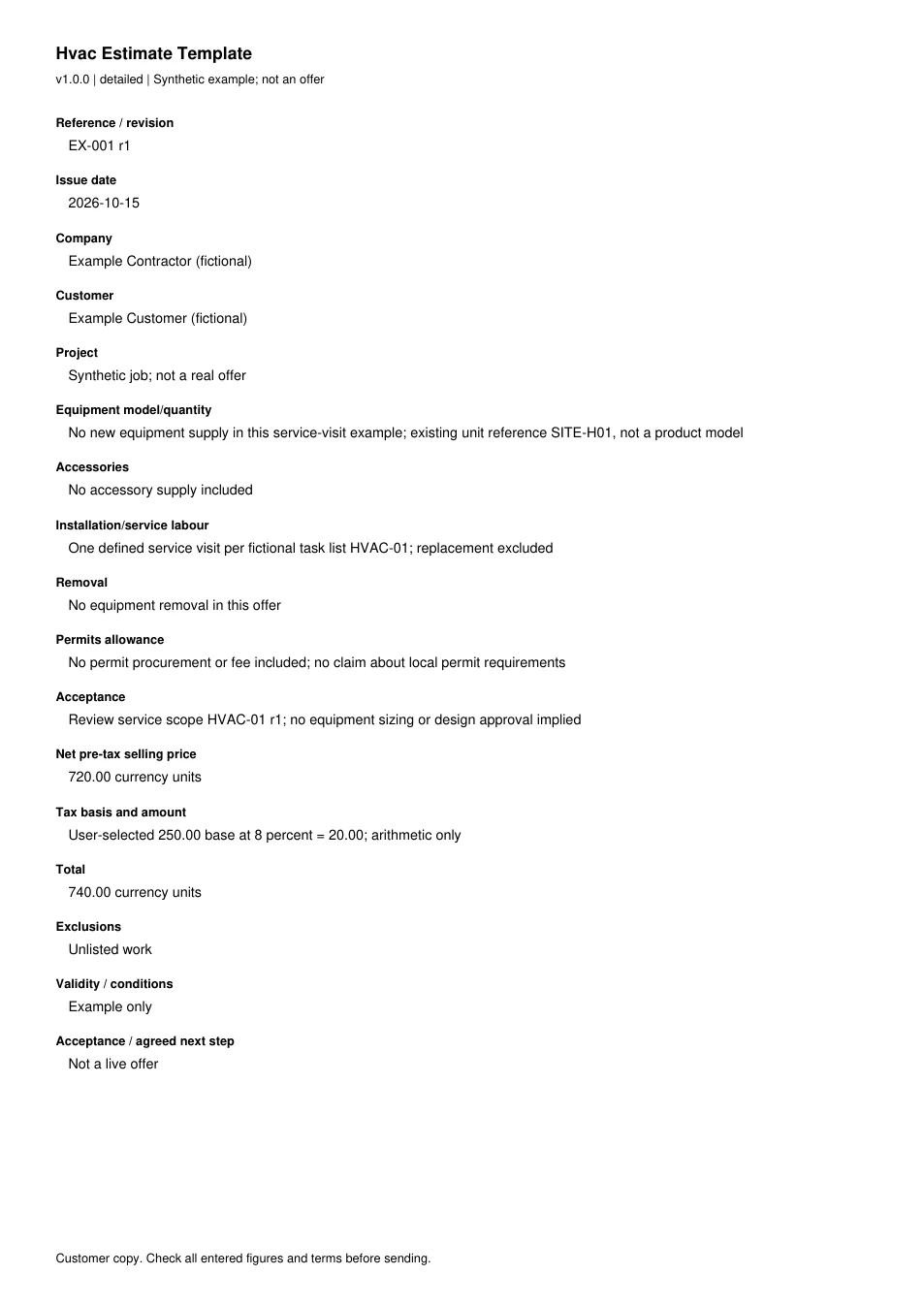
Read every field in the example
- Reference / revision
- EX-001 r1
- Issue date
- 2026-10-15
- Company
- Example Contractor (fictional)
- Customer
- Example Customer (fictional)
- Project
- Synthetic job; not a real offer
- Equipment model/quantity
- No new equipment supply in this service-visit example; existing unit reference SITE-H01, not a product model
- Accessories
- No accessory supply included
- Installation/service labour
- One defined service visit per fictional task list HVAC-01; replacement excluded
- Removal
- No equipment removal in this offer
- Permits allowance
- No permit procurement or fee included; no claim about local permit requirements
- Acceptance
- Review service scope HVAC-01 r1; no equipment sizing or design approval implied
- Net pre-tax selling price
- 720.00 currency units
- Tax basis and amount
- User-selected 250.00 base at 8 percent = 20.00; arithmetic only
- Total
- 740.00 currency units
- Exclusions
- Unlisted work
- Validity / conditions
- Example only
- Acceptance / agreed next step
- Not a live offer