
Junk Removal Estimate Template (2026): Editable Worksheet and Example

On this page7
A junk removal estimate template states what will be removed and how the load is measured. Separate access, lifting, transport and disposal. A photo or rough volume scope note does not check every item or the receiving facility charge.
List items or declared load units, access constraints, handling scope, transport and disposal basis. State excluded waste clearly. Keep unknown contents and receiving fees open until known. The form does not classify hazardous waste, approve disposal or give lifting instructions. It records the price service you actually offer.
Page updated 25 October 2026. Source check dates are reported separately in the text and comparison.
Junk Removal Estimate Template preview
| Trade field | Blank entry rule | Filled synthetic example |
|---|---|---|
| Item inventory | Name the goods included | Listed household furniture and boxes |
| Load unit | Declare the volume or item basis | User-measured load, not a guessed truck fraction |
| Access | Record stairs, carry distance and entry | One stair flight noted |
| Handling | State the included labour task | Listed items only |
| Transport | Name included trip basis | One planned trip in the example |
| Disposal | Use real receiving basis | Fee open until item list checked |
| Excluded waste | State unaccepted goods | Unlisted or restricted waste excluded |
| Extra items | Keep outside base scope | Added appliance needs separate review |
Scroll for more →
Define the load before the price
Use an item list where it is more reliable than a rough volume. If you use load units, define them and state how the amount is checked. A fraction of a vehicle is not a fixed unit across operators. Avoid presenting a vague “small load” as a measured amount.
Record the access route. Note stairs, carry distance and parking. The same item list can take different work on a different route. A cost entry does not prove that the handling method is safe. This page gives no lifting or waste-handling steps.
Mixed household example
A made-up job includes a defined list of furniture and boxes. The base scope covers handling, a stated trip and the named waste route. An appliance added later needs a new decision. Spare vehicle space does not automatically include that appliance in the offer.
Tie disposal charges to the actual items and receiving basis. Keep an unknown fee unresolved. Do not assume restricted waste will be accepted. Household items may need different disposal routes.
Issue a clear service offer
Show the included inventory, access basis notes, trip basis and exclusions. Explain how added items affect the offer under your real terms. Keep the first list with the sent version so the revised scope has a traceable basis.
Keep the price build-up private and send the checked selling amounts. For a broader property clean, see cleaning estimates. The scope method follows the GAO guide, checked 15 October. It does not approve a waste classification or check local disposal costs.
Cost an inventory with a second-trip decision
This fictional collection lists one sofa, two chairs and eight boxes. The inventory also records which items are upstairs and the carry route to the vehicle. Suppose the checked loading plan permits the listed goods in one trip. That is a job-specific planning input, not a promise that any vehicle can carry the same count or weight.
The example has two people for three clock hours of handling. That is six person-hours. At an invented $27 cost per person-hour, handling costs $162.
Add $65 for the defined vehicle trip and a fictional quoted receiving fee of $85 for the accepted inventory. Known cost is $312. Do not multiply the six person-hours by two again; the worker count is already included.
If the receiving fee is not yet confirmed, show $227 as the known handling and trip cost with disposal open. Do not publish $227 as an all-inclusive removal price. The receiving route may reject an item or charge on a different basis, and a photo cannot settle that issue.
Work the added-item case
Suppose the client adds a cabinet that the agreed loading plan cannot include in the first trip. Once handling and acceptance are resolved, the example extra scope has two more person-hours, another $65 trip and $20 of added receiving fees. Extra cost is $139: 54 plus 65 plus 20. Revised known cost is $451.
The extra cost is not just the cabinet's disposal fee. The second trip is what changes the result. On another job, an added accepted item might fit the first trip, but that needs its own checked basis. Do not assume either outcome from spare space in a photograph.
Make the receiving fee checkable
Keep the receiving quote, its date and the inventory it covers. If the facility charges by weight, record the quoted rate and any minimum separately from an unconfirmed weight. A load volume does not convert into a verified disposal weight. Keep any conditional amount visible until the actual basis is resolved.
The quote should state who clears the route and which goods remain. Mark items the client intends to keep so “clear the room” does not become the removal of everything visible. If items change before the visit, compare the new inventory with the accepted one before revising the amount.
Keep unaccepted waste out of the priced service. This example does not classify waste or provide handling instructions. It shows the cost effect of a defined inventory, access basis and trip count. Use the pack field definitions for later pricing steps, while retaining the inventory and receiving evidence with this removal estimate.
FAQ
What if the client removes some goods first?
Compare the new list with the accepted inventory. Check whether the load still needs the same trip and receiving minimum. Less furniture does not always remove a full trip charge. Rework handling time for the items that remain, using the real access route. Keep the new list dated and name any changed credit under the actual offer. Do not treat an empty space in the room as proof that all costs fall by the same share. The remaining load still needs a clear destination.
Check whether the receiving quote covers the same inventory as the client list. Keep item changes dated so a final fee can be traced to the accepted load.
Can I price from a load photo alone?
A photo can help you list the work. It may miss items, stairs or the route to the vehicle. Ask for those facts. Keep any unknown item open. Check the inventory and receiving fees before giving a complete price. A photo does not prove that the waste facility will accept the load.
How do I handle extra items?
List them as a scope change with any new handling, transport or disposal basis. State if they are accepted and how the price changes under your real offer. Keep the first inventory so the client can see the difference. Unlisted items should not disappear into an unexplained final charge.
Verdict on the junk removal estimate template
Use the junk removal estimate template for a defined inventory, access basis and disposal scope. Treat added items as changes. Check the pack calculation for totals and the trade directory for other property services.
Inside the original file
This is the actual A4 example from the editable pack, version 1.0.0. All names, measurements, dates and amounts are invented for the form demonstration.
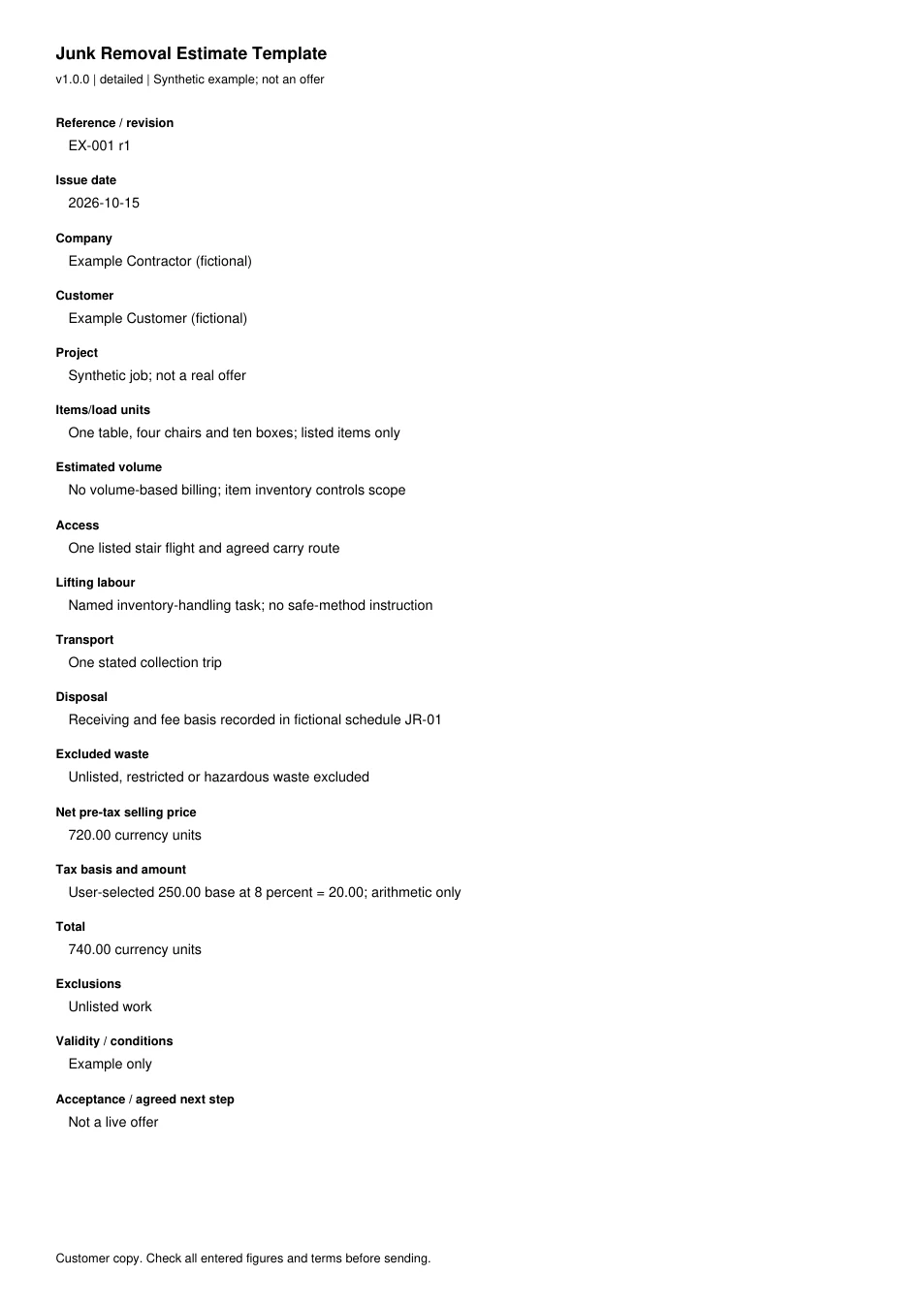
Read every field in the example
- Reference / revision
- EX-001 r1
- Issue date
- 2026-10-15
- Company
- Example Contractor (fictional)
- Customer
- Example Customer (fictional)
- Project
- Synthetic job; not a real offer
- Items/load units
- One table, four chairs and ten boxes; listed items only
- Estimated volume
- No volume-based billing; item inventory controls scope
- Access
- One listed stair flight and agreed carry route
- Lifting labour
- Named inventory-handling task; no safe-method instruction
- Transport
- One stated collection trip
- Disposal
- Receiving and fee basis recorded in fictional schedule JR-01
- Excluded waste
- Unlisted, restricted or hazardous waste excluded
- Net pre-tax selling price
- 720.00 currency units
- Tax basis and amount
- User-selected 250.00 base at 8 percent = 20.00; arithmetic only
- Total
- 740.00 currency units
- Exclusions
- Unlisted work
- Validity / conditions
- Example only
- Acceptance / agreed next step
- Not a live offer