
Lawn Care Estimate Template (2026): Editable Worksheet and Example

On this page7
A lawn care estimate template distinguishes a service visit from a period contract. List mowing, edging and other chosen tasks with the service area and frequency. A seasonal amount needs a defined basis rather than an assumed number of visits.
Record the service boundary, tasks, visit frequency, labour and consumables. Show a per-visit price and a period price only with a clear visit rule. Keep one-off cleanup and other options separate. The form supplies no universal mowing time, growth forecast or automatic seasonal visit count. Enter the actual agreed service basis.
Page updated 25 October 2026. Source check dates are reported separately in the text and comparison.
Lawn Care Estimate Template preview
| Trade field | Blank entry rule | Filled synthetic example |
|---|---|---|
| Service area | Measure or set out real boundary | Front and rear lawn apart |
| Mowing | State included areas and handling | Listed lawn only |
| Edging | Name borders included | Defined paths and bed edges |
| Clippings | State included handling | User-defined collection or return basis |
| Frequency | Record real schedule or trigger | Client-chosen service plan |
| Visits | State count or contract rule | User-entered period count |
| Consumables | Use your own cost basis | Real service inputs |
| Extras | Keep outside base work | Initial cleanup optional |
Scroll for more →
Define the visit
Mark the service boundary and list each task. A lawn area does not tell the client if edging, clipping collection or access cleanup is included. Keep those tasks clear. State what the client needs to clear before the visit and which areas remain outside the offer.
Use your own time basis for the actual scope. Access and obstacles can change the task. So can the selected services, even at the same area. A generic production rate is not a measurement of this site.
Recurring visit example
An imaginary property has mowing and edging on a chosen schedule. The worksheet shows a visit price and a user-entered planned count. A separate initial cleanup remains an unselected option. It does not silently become part of every visit.
For a fixed seasonal price, state the period and service limits. For billing per visit, keep a log of actual work. These are different ways to bill. A planned visit count is only a forecast. Do not present it as a promise of that many services.
Keep changes traceable
A changed area or frequency needs an updated scope. Record the date and the new basis before changing a recurring amount. Keep the prior offer so a later invoice can be matched to the right service period.
For installation work, use landscaping. For winter service, use snow removal. The GAO guide supports documented assumptions and updates. It does not predict growth, weather or market rates. Checked 15 October.
Build a visit cost before a seasonal scenario
This invented mowing plan covers separate front and rear lawn areas plus the named path edging. The time notes allow 45 minutes for mowing, fifteen for edging and fifteen for the agreed clipping and access cleanup. Total task time is 75 minutes, or 1.25 person-hours. At a fictional labour cost of $26 per person-hour, labour costs $32.50.
Add $7.50 for the example's stated consumables and equipment-use basis and $10 for the visit's travel allocation. Private visit cost is $50. None of those inputs comes from a universal square-feet-per-hour rate. They are invented to show the time conversion and the difference between a task plan and a measured lawn area.
Suppose a planning scenario uses eighteen visits in a named season. Eighteen times $50 gives $900 cost. A separate initial cleanup needs three person-hours and $12 of goods in this exercise. Its cost is $90.
If selected, the scenario totals $990. The cleanup does not become part of each of the eighteen visits.
Test an altered service boundary
If a rear section leaves the service, rework the affected tasks. Suppose the revised plan removes fifteen minutes of mowing but leaves travel and edging unchanged. Labour falls by $6.50 at the example rate. Visit cost becomes $43.50 if the other inputs truly stay the same. Cutting the whole $50 by the removed area's percentage would not follow this task basis.
Mark the revised boundary and effective date. A later invoice must use the right service version. If the client adds clipping collection, record the handling and receiving basis rather than assuming it is already covered by the original cleanup description. Keep one-off leaf or storm work distinct from routine clipping cleanup.
Check forecast visits against completed visits
The eighteen-visit scenario is not a weather or growth forecast. If only sixteen visits occur under actual-visit billing, the service log records sixteen. Apply the agreed billing terms to those records. A fixed seasonal agreement may use a different rule, so do not turn a planning scenario into an automatic invoice.
State how moved dates and unavailable access are handled under the actual offer. Keep a planned date, a completed date and a cancellation distinguishable. The client should be able to match the bill to the stated service basis without seeing your private labour cost.
Use the shared pack field reference for general pricing inputs. This lawn's boundary, task minutes and chosen visit rule remain the basis for the recurring amount. Recheck them when the site or schedule changes.
FAQ
How do I price a change from weekly to less frequent visits?
Recheck the tasks and time per visit as well as the count. Do not halve a period price solely because there are fewer planned dates. The work needed on each date may differ. Keep the real site basis in the new offer and say when the schedule changes. If the task plan stays the same, state that assumption. Match the next invoice to the accepted version and actual billing rule. A calendar change should not silently remove edging or clipping duties.
Can I multiply a visit price into a season?
You can show a scenario using a stated user-entered count, but label it as that scenario. A seasonal agreement needs its own real service and billing terms. The form does not forecast weather or growth. Keep planned visits and completed visits distinct so an estimate is not presented as a service record.
Is initial cleanup part of mowing?
Only if you clearly include it. Name its work limit and price basis. A one-off cleanup and repeat maintenance can take distinct work and should remain separate in the scope. If the client selects the cleanup later, revise the offer or record the agreed change rather than hiding it in the visit rate.
How should a missed visit appear in the record?
Record the planned date and why the visit did not take place. State whether it was moved or cancelled. Apply the actual billing terms. Do not count a planned visit as completed work. Keep the revised date with the service log so the next bill follows the agreed schedule.
Verdict on the lawn care estimate template
Use the lawn care estimate template to define a visit and its continuing schedule. Keep cleanup options and seasonal scenarios separate. Check the pack example for the price sequence and the trade directory for installation work.
Inside the original file
This is the actual A4 example from the editable pack, version 1.0.0. All names, measurements, dates and amounts are invented for the form demonstration.
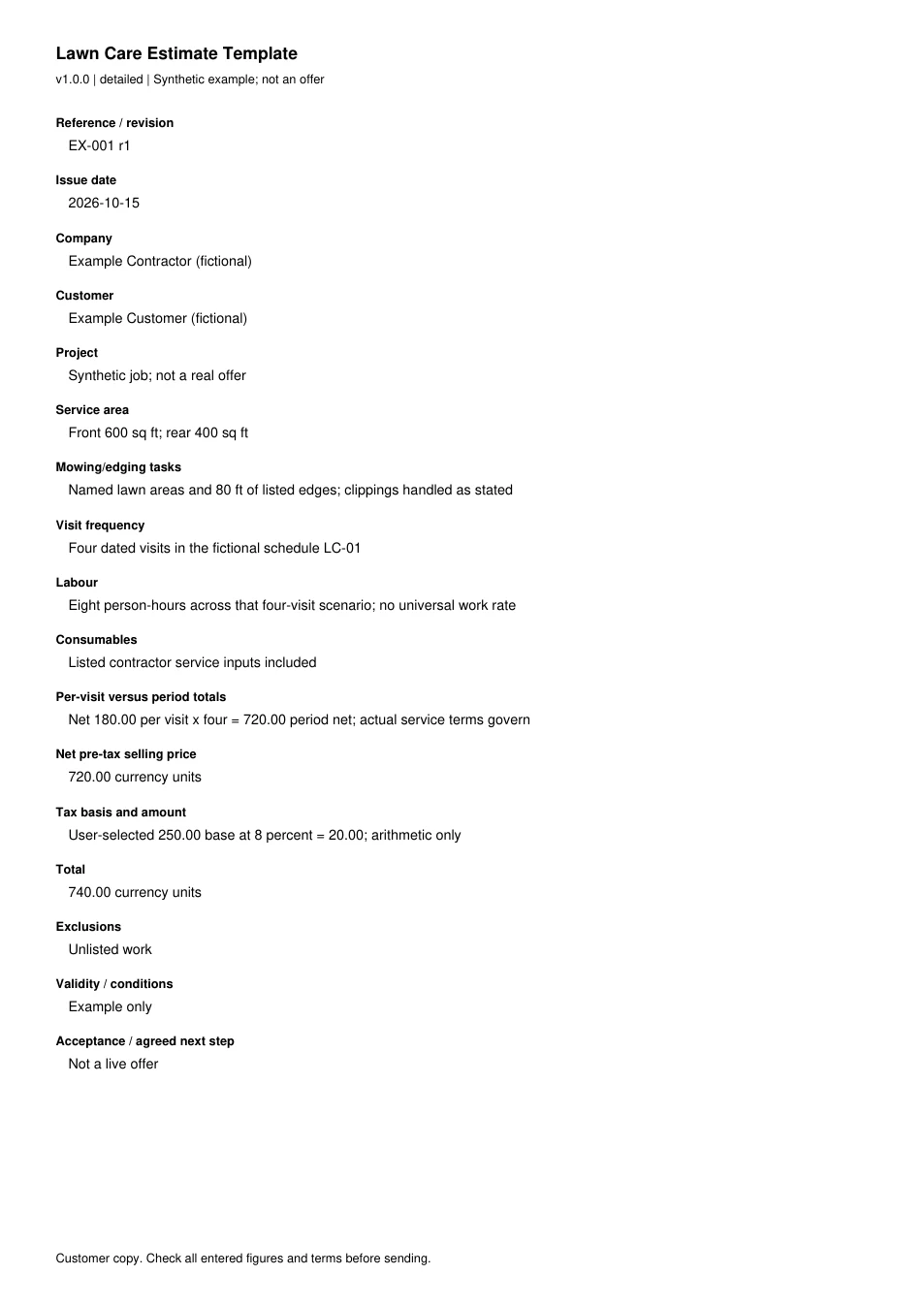
Read every field in the example
- Reference / revision
- EX-001 r1
- Issue date
- 2026-10-15
- Company
- Example Contractor (fictional)
- Customer
- Example Customer (fictional)
- Project
- Synthetic job; not a real offer
- Service area
- Front 600 sq ft; rear 400 sq ft
- Mowing/edging tasks
- Named lawn areas and 80 ft of listed edges; clippings handled as stated
- Visit frequency
- Four dated visits in the fictional schedule LC-01
- Labour
- Eight person-hours across that four-visit scenario; no universal work rate
- Consumables
- Listed contractor service inputs included
- Per-visit versus period totals
- Net 180.00 per visit x four = 720.00 period net; actual service terms govern
- Net pre-tax selling price
- 720.00 currency units
- Tax basis and amount
- User-selected 250.00 base at 8 percent = 20.00; arithmetic only
- Total
- 740.00 currency units
- Exclusions
- Unlisted work
- Validity / conditions
- Example only
- Acceptance / agreed next step
- Not a live offer