
Tree Removal Estimate Template (2026): Editable Worksheet and Example

On this page7
A tree removal estimate template names each tree and the real removal scope. Keep trimming, haulage and stump work separate. A size note is plain. It does not check a safe method, site risk or a fixed price.
Use a tree identifier and location for each included task. Record user size notes, access, removal or trimming scope, haulage and stump option. State exclusions and open conditions. The worksheet gives no felling, climbing, rigging or utility-clearance instructions and does not claim that a made-up example was a completed job.
Page updated 25 October 2026. Source check dates are reported separately in the text and comparison.
Tree Removal Estimate Template preview
| Trade field | Blank entry rule | Filled synthetic example |
|---|---|---|
| Tree ID | Use a site plan or clear identifier | Tree A by the named boundary |
| Size notes | Record real plain details | User-entered size. Not a price formula |
| Task | Separate removal and trimming | Removal of identified tree only |
| Access | State the real work basis notes | Entry and goods route to be checked |
| Haulage | Name included goods handling | Defined branch and timber removal |
| Stump option | Keep selection distinct | Stump work outside the base example |
| Site limits | Record adjacent constraints as known | Open conditions stay open |
| Exclusions | State work not offered | Unlisted trees and ground restoration |
Scroll for more →
Name the work clearly
A tree scope note needs a location or plan record ID. “Large tree at the back” may not be enough when several trees stand together. Use a marked site record ID that both parties can match. Keep plain height or size notes separate from any trade conclusion.
State if the task is removal, trimming or another defined service. Do not let a general tree-care label imply unlimited work. Keep permissions and real site needs tied to the job. The form does not check authority to remove a tree.
Removal and stump example
A made-up offer removes identified Tree A and includes the named haulage. Stump work is a separate unselected option. Ground restoration is outside the base scope. The client can see that removing the above-ground tree does not on its own include every later task.
If stump work is chosen, add its real scope and conditions. Keep the record ID and total aligned. Do not imply a particular access method or trade solution from a cost line. Those choices require the real site needs.
Check goods handling and output
Set out what happens to branches, timber and remaining goods. Keep the receiving or disposal basis in private costing as needed. If the client keeps goods, state that choice and its boundary so haulage is not counted twice.
Use landscaping for separately defined planting or restoration and junk removal for other listed items. Scope records follow the GAO guide, checked 15 October. It does not validate safety, permissions or local rates.
Cost identified trees and selected haulage
This made-up scope removes Tree A and lists a defined trim on Tree B. The plan has eight person-hours for Tree A and four for Tree B. At an invented $32 cost per person-hour, labour costs $256 and $128. These times only show how the price math works. They do not choose a crew, tools or safe work method.
The private plan also has $180 for the defined equipment basis, $120 for haulage and $85 of confirmed receiving charges for the listed material. Known base cost is $769: 256 plus 128 plus 180 plus 120 plus 85. Tree C is visible on the site sketch but outside the work. Its presence in a photo does not make it part of the priced removal.
Suppose a separately resolved stump option adds $140 of equipment cost and three person-hours at the same example rate. Extra cost is $236. If selected, known cost becomes $1005. The option does not include ground restoration unless that work is separately described. Keep the stump task linked to Tree A so it cannot be mistaken for work on every stump at the property.
Test the client's decision to retain timber
If the client keeps the defined timber on site, check which haulage and receiving costs actually disappear. Do not automatically subtract the whole $205 haulage-plus-fee amount if branches or other listed material still need removal. Rework the load and receiving basis for the material that remains in the service.
Record where retained material is to remain and the agreed handling boundary. A client choice to keep timber may change handling work even when it reduces transport. Keep the resulting task basis with the revised estimate rather than treating retained material as a simple percentage discount.
Keep identifiers consistent through the offer
Use the same Tree A and Tree B labels on the sketch, scope and price record. Keep removal and trimming apart. If the client switches the tree to remove, make a new task plan. Do not move the old price to it just because the trees look alike in a photo.
Check permissions, site conditions and any unresolved service needs before presenting the known subtotal as a complete commitment. The estimate is not evidence that these matters have been resolved. It supplies no felling, climbing or utility-clearance instruction.
Use the shared cost-field definitions for the general selling-price steps. Keep the tree identifiers, haulage choice, stump selection and open site matters with this tree-service record. They are the decisions that explain the example's different totals.
FAQ
What if the client adds ground repair?
Give it a new scope with a marked area and a clear end point. Name the goods, work and handover duties that you offer. Keep it separate from tree removal and stump work. A charge for taking away branches does not price soil, planting or later care. If the ground condition is still open, keep the added amount open too. The client should see which part of the site each task covers before choosing it. Link any accepted addition to the revised offer.
Before sending, compare the tree labels in the written scope with the marked site record. Check that retained timber, removed branches and the selected stump task each have a clear destination or work boundary.
Does removal include the stump?
Only if the offer states that work. Keep stump treatment or removal as a defined included item or a separate option, with its real scope. Ground restoration may be another distinct task. Do not let the single word “removal” imply every possible follow-on service in the client copy.
Can a tree size decide the price?
Size is one plain input, but the real task, access, handling and site needs also matter. This form supplies no fixed price formula or safe method. Record your own cost basis and open conditions. A made-up tree example is not evidence of a real site inspection or completed removal.
Verdict on the tree removal estimate template
Use the tree removal estimate template for identified trees and a defined service boundary. State haulage and stump work explicitly. The pack arithmetic supports pricing records, while the trade directory links separate restoration tasks.
Inside the original file
This is the actual A4 example from the editable pack, version 1.0.0. All names, measurements, dates and amounts are invented for the form demonstration.
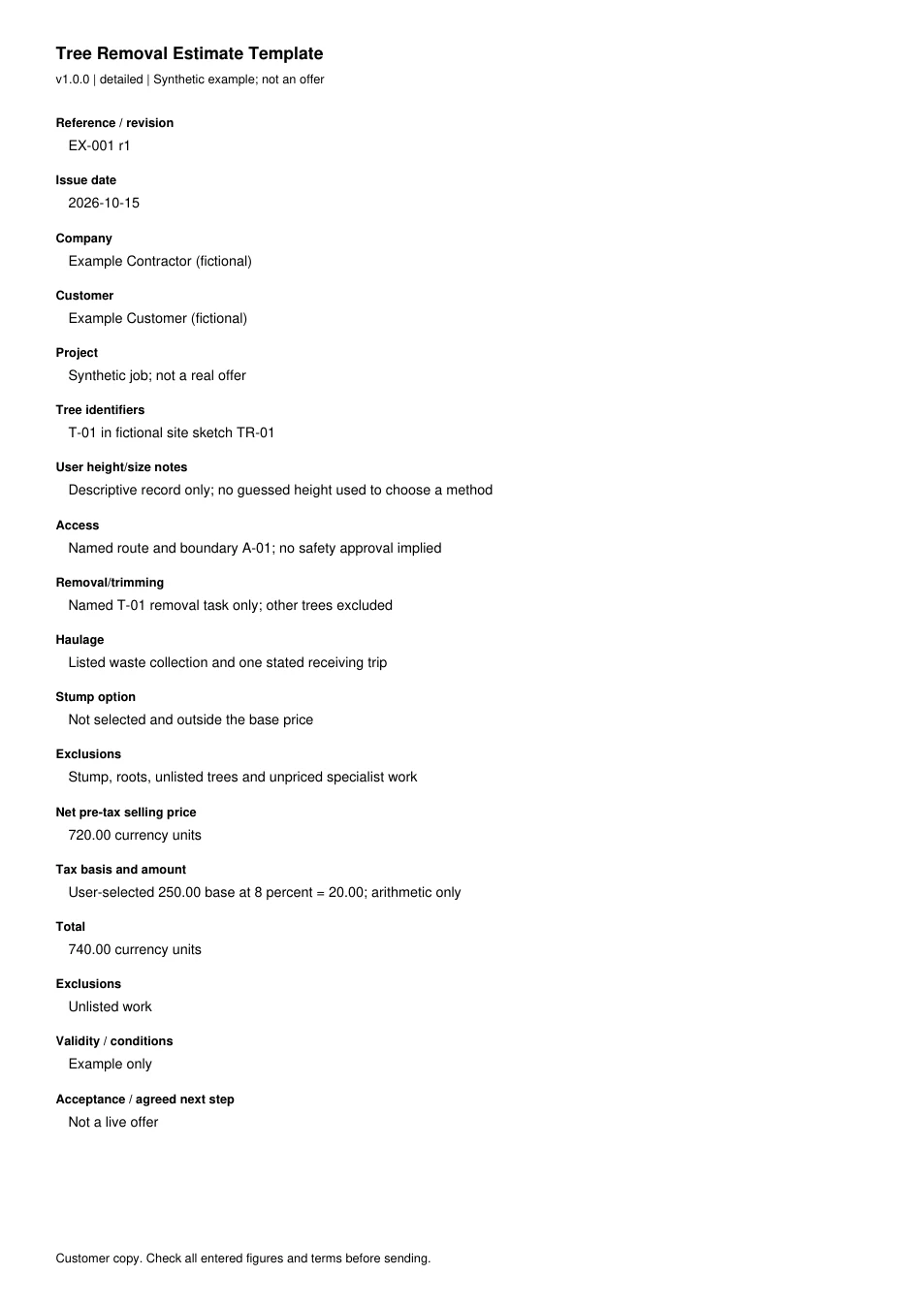
Read every field in the example
- Reference / revision
- EX-001 r1
- Issue date
- 2026-10-15
- Company
- Example Contractor (fictional)
- Customer
- Example Customer (fictional)
- Project
- Synthetic job; not a real offer
- Tree identifiers
- T-01 in fictional site sketch TR-01
- User height/size notes
- Descriptive record only; no guessed height used to choose a method
- Access
- Named route and boundary A-01; no safety approval implied
- Removal/trimming
- Named T-01 removal task only; other trees excluded
- Haulage
- Listed waste collection and one stated receiving trip
- Stump option
- Not selected and outside the base price
- Exclusions
- Stump, roots, unlisted trees and unpriced specialist work
- Net pre-tax selling price
- 720.00 currency units
- Tax basis and amount
- User-selected 250.00 base at 8 percent = 20.00; arithmetic only
- Total
- 740.00 currency units
- Exclusions
- Unlisted work
- Validity / conditions
- Example only
- Acceptance / agreed next step
- Not a live offer