
Invitation To Bid Template (2026): Editable Pack and Example

On this page8
An invitation to bid template gives each bidder the same work to price. State the work, files, response fields and deadline before asking for a figure. A clear request helps you compare the bids. It can cut down on late scope queries.
Send the same scope revision to every invited bidder. State how to ask a question. Add site access details. Give the bid due date with its time zone. List the price fields you need. Give each change a number. State how you will choose. Keep each sent bid intact when it arrives.
Page updated 25 October 2026. Source check dates are reported separately in the text and comparison.
Invitation to bid template fields
| Field | Instruction |
|---|---|
| Invitation record ID | A unique package record ID and revision |
| Work scope note | Location, work boundaries and deliverables |
| File register | Drawing/spec titles and revisions |
| Site visit | Arrangements, if relevant, with a working contact route |
| Questions | Contact person, method and question cut-off |
| Submission | Exact destination, file format and needed attachments |
| Deadline | Date, time and time zone |
| Evaluation | Stated price and non-price needs |
| Addenda | List issued changes and ask bidders to acknowledge them |
Scroll for more →
Prepare the invitation to bid template
Start with the outcome you need. A title such as “flooring” leaves gaps. State whether removal, preparation, fitting and waste handling are included.
Divide the scope into defined actions. State which items the buyer supplies and who checks counts.
Attach a file register instead of relying on an email thread. A bidder should be able to tell which revision of each file controls the request. Use the same names in the invitation and attachments. If an older file is withdrawn, name it so it is not priced by mistake.
Choose response fields that support the choice. A base amount, named alternates, exclusions and expected lead time often matter more than a large generic questionnaire. Ask for the evidence the job actually needs. Do not ask for a licence or other proof unless it applies.
Handle questions and changes
Set one route for scope questions. Record answers that change the package and send the same clarification to every affected bidder. Keep bidders' private commercial details separate. Everyone pricing the changed work needs the same scope baseline.
Use an addendum for a changed plan, count or deadline. Name what changed and if an earlier response must be revised. Give the bidders enough details to respond to the amended request. This form does not supply mandatory public-buying procedures or legal deadlines.
Worked invitation example
An imaginary property team asks for storage-room shelving bids. The invitation lists the room plan, shelf schedule and access hours. It requests fitting and packaging removal, with wall painting outside the package. Each bidder must state if the offered date depends on owner-supplied goods arriving first.
Before the deadline the buyer adds one shelf bay. Addendum 1 replaces the shelf schedule and asks each bidder to acknowledge that version. Returned proposals can now be checked against the same count. If someone did not receive the addendum, resolve that issue before treating the bid as comparable.
Receive and compare responses
Record receipt time and file names. Keep the first bid intact. Transfer the known amounts and scope notes into the bid tabulation sheet and record unanswered items apart. An empty response field is a question, not a checked exclusion or a zero cost.
For the bidder's outgoing file, see the bid proposal template. For a vendor pricing request with a more focused goods-and-count schedule, use the request for quote.
Method source
The GAO cost guide supports a defined baseline and recorded basis notes. This first invitation applies those ideas to a small private package. It does not claim to be a prescribed government tender. Checked 15 October.
Full revision date is shown above.
FAQ
Is an invitation the same as a contract?
It asks for offers against the stated scope. The legal effect of the invitation, response and later acceptance depends on their wording and linked rules. Do not assume this blank form creates the agreement you need. Keep the invitation and any resulting agreement clearly identified in the project record.
Should every bidder receive the same files?
Each bidder pricing the same package needs the same scope baseline. Record who receives the files and issue revisions consistently. A file sent only to one bidder can produce prices that appear comparable but cover different work. Resolve that difference before comparing totals or choosing a vendor.
Verdict on the invitation to bid template
The invitation to bid template works when the scope and response method are clear before it leaves your desk. Use the resulting bids as first records. Then compare resolved scope.
Inside the original file
This is the actual A4 example from the editable pack, version 1.0.0. All names, measurements, dates and amounts are invented for the form demonstration.
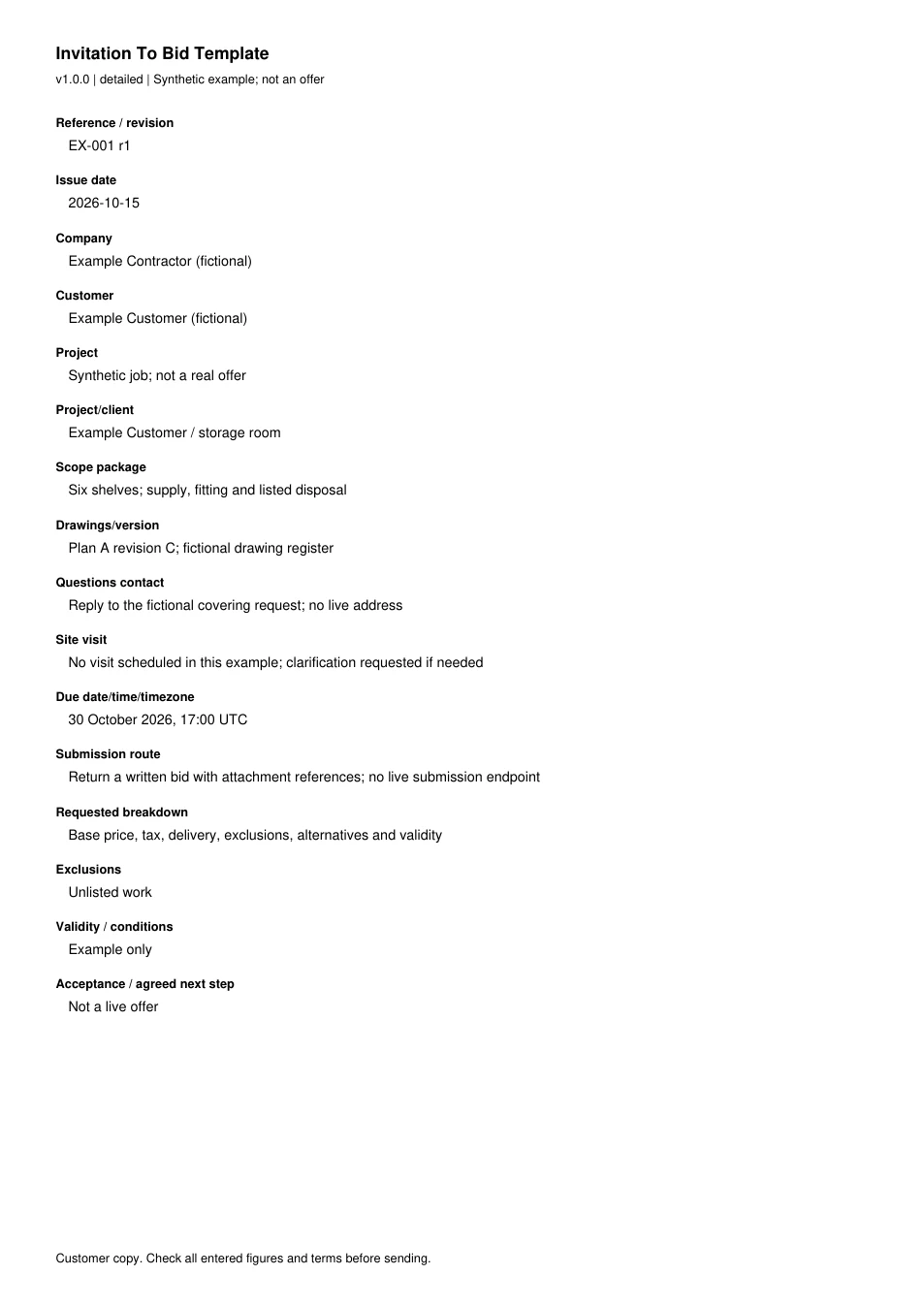
Read every field in the example
- Reference / revision
- EX-001 r1
- Issue date
- 2026-10-15
- Company
- Example Contractor (fictional)
- Customer
- Example Customer (fictional)
- Project
- Synthetic job; not a real offer
- Project/client
- Example Customer / storage room
- Scope package
- Six shelves; supply, fitting and listed disposal
- Drawings/version
- Plan A revision C; fictional drawing register
- Questions contact
- Reply to the fictional covering request; no live address
- Site visit
- No visit scheduled in this example; clarification requested if needed
- Due date/time/timezone
- 30 October 2026, 17:00 UTC
- Submission route
- Return a written bid with attachment references; no live submission endpoint
- Requested breakdown
- Base price, tax, delivery, exclusions, alternatives and validity
- Exclusions
- Unlisted work
- Validity / conditions
- Example only
- Acceptance / agreed next step
- Not a live offer